
Table of Contents
ToggleChoosing the right knitting machine is an important decision for manufacturers looking to improve production efficiency, fabric quality, and overall productivity. The right machine can help businesses meet production targets while maintaining consistency and reducing unnecessary operational costs.
For manufacturers in Ludhiana and across India, Knitnsew understands that machine selection should be based on specific production requirements rather than a one-size-fits-all approach. Factors such as fabric type, design complexity, production volume, yarn requirements, and end-product applications all play a role in determining the most suitable knitting technology.
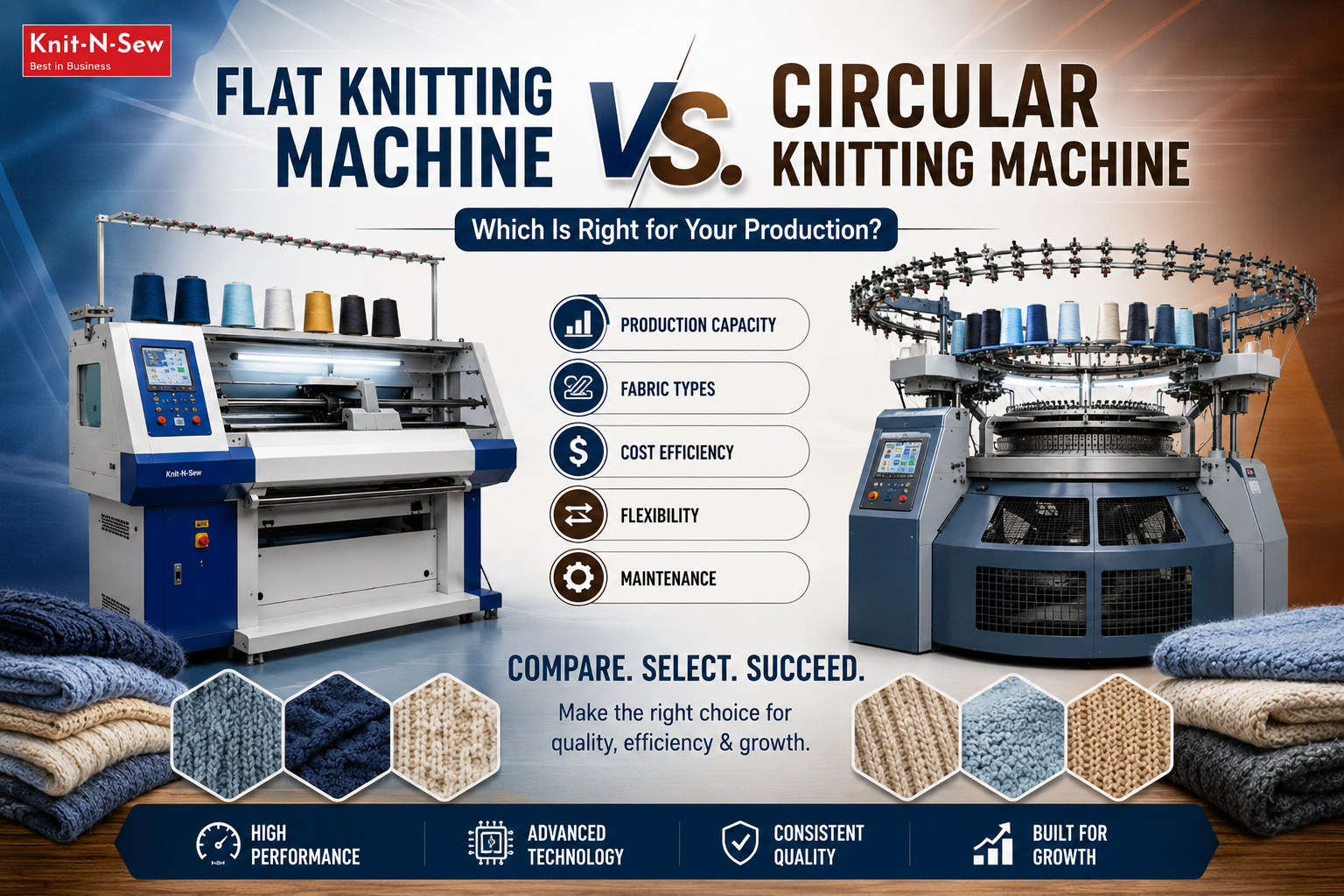
Two widely used options in the textile industry are flat knitting machines and circular knitting machines. While both are designed for efficient fabric production, they differ in construction, working methods, fabric applications, and production capabilities.
In this guide, we’ll compare flat and circular knitting machines to help you understand their key differences and determine which option is better suited to your production needs.
Flat Knitting Machine vs. Circular Knitting Machine: At a Glance
Flat knitting machines and circular knitting machines are two widely used technologies in modern textile manufacturing, but each serves different production requirements. A flat knitting machine creates fabric by forming knitted loops across flat needle beds, making it suitable for shaped, structured, and fully fashioned garments such as sweaters, collars, cuffs, and other intricate designs. It offers greater flexibility for patterns, textures, and garment shaping.
In contrast, a circular knitting machine uses needles arranged in a circular cylinder to continuously produce tubular fabric. This makes it highly efficient for large-volume production of fabrics used in T-shirts, sportswear, innerwear, leggings, and other stretchable garments.
The key difference lies in fabric formation and production focus. Flat knitting machines are generally preferred when design flexibility, shaping, and customization are important, while circular knitting machines are better suited for continuous fabric production, high output, and consistent fabric construction.
For manufacturers, including those working with Knitnsew in Ludhiana, the right choice depends on fabric specifications, production volume, garment type, and desired level of customization.
How Does a Flat Knitting Machine Work?
A flat knitting machine uses a needle bed and carriage system to produce knitted fabric with precision and flexibility. The needle bed holds multiple needles in a straight arrangement, while the carriage moves across the bed, controlling the needles and yarn to create stitches. As the carriage moves back and forth, loops are formed course by course, gradually building the fabric into the required shape and pattern. This controlled process allows manufacturers to produce detailed designs, textures, and shaped panels. Flat knitting machines are commonly used for sweaters, cardigans, collars, cuffs, scarves, and other fully fashioned garments. Knitnsew provides knitting solutions suitable for varied textile production requirements.
How Does a Circular Knitting Machine Work?
A circular knitting machine uses needles arranged around a circular needle cylinder to form knitted fabric continuously. As the cylinder rotates, the needles move through different knitting zones, capturing yarn and forming interconnected loops. Unlike flat knitting machines, which work back and forth across a needle bed, circular machines can produce fabric in a continuous tubular form, making them highly efficient for large-scale production.
Circular knitting machines are commonly used to manufacture single jersey, rib, interlock, and other knitted fabrics. These fabrics are widely used in T-shirts, sportswear, innerwear, leggings, casual clothing, and other stretchable garments. Their high production speed and consistent output make circular knitting machines a popular choice for manufacturers focused on volume and efficiency. Knitnsew offers knitting machine solutions designed to support diverse textile manufacturing requirements.
Flat vs. Circular Knitting Machine: Key Differences
| Feature | Flat Knitting Machine | Circular Knitting Machine |
| Production Speed | Moderate speed; suitable for detailed and shaped garment production | High speed; ideal for continuous, high-volume production |
| Fabric Structure | Produces flat panels and shaped knitted pieces | Produces continuous or tubular knitted fabric |
| Design Flexibility | Excellent for patterns, textures, shaping, and intricate designs | Best suited for consistent structures and repeated patterns |
| Fabric Width & Shape | Suitable for specific widths, panels, and garment shapes | Suitable for continuous fabric rolls or tubular structures |
| Automation & Productivity | Advanced automation available for precise garment production | Highly productive with automated continuous knitting processes |
| Material & Yarn Requirements | Flexible for different yarn types, gauges, and garment constructions | Yarn selection depends on fabric type, gauge, and machine configuration |
| Common Applications | Sweaters, cardigans, collars, cuffs, scarves, and fully fashioned garments | T-shirts, sportswear, innerwear, leggings, and other knitted fabrics |
| Best For | Customization, shaping, and complex garment designs | High-volume fabric production and consistent output |
| Main Advantage | Greater design and shaping flexibility | Faster and more efficient continuous production |
Which Machine Is Better for Different Production Needs?
Choosing between a flat knitting machine and a circular knitting machine depends largely on the type of fabric, garment, production volume, and level of customization required. Here’s a quick guide to help manufacturers identify the better option for different applications.
| Production Need | Recommended Machine | Why? |
| Sweaters & Knitwear | Flat Knitting Machine | Ideal for shaped garments, sweaters, cardigans, collars, cuffs, and detailed knitwear designs. |
| T-Shirts & Seamless Garments | Circular Knitting Machine | Suitable for continuous fabric production and commonly used for T-shirts, sportswear, innerwear, and stretch garments. |
| Rib & Tubular Fabrics | Circular Knitting Machine | Efficient for producing continuous and tubular structures with consistent fabric formation. |
| Fashion & Customized Designs | Flat Knitting Machine | Offers greater flexibility for intricate patterns, textures, color combinations, and garment shaping. |
| Large-Volume Fabric Production | Circular Knitting Machine | Designed for continuous, high-output production, making it suitable for manufacturers focused on volume and efficiency. |
For manufacturers in Ludhiana, Knitnsew can help evaluate machine requirements based on fabric type, production capacity, yarn specifications, and end-use applications. The best machine is ultimately the one that matches your specific production goals rather than simply offering the highest output.
Flat Knitting Machine: Advantages & Limitations
A flat knitting machine is widely used for producing shaped and customized knitted garments. Its ability to control individual needles and create different stitch patterns makes it particularly valuable for fashion-focused and fully fashioned knitwear production.
Advantages
- Design Versatility: Supports intricate patterns, textures, color combinations, and different stitch structures, making it suitable for creative knitwear designs.
- Excellent Shaping Capabilities: Fabric panels can be shaped during knitting, helping produce garments with fewer cutting and sewing requirements.
- Suitable for Specialized Applications: Commonly used for sweaters, cardigans, collars, cuffs, scarves, fashion knitwear, and other customized garments.
Limitations
- Production Speed: Flat knitting machines generally operate at a slower production rate than circular machines for continuous fabric manufacturing.
- Production Volume: They may not be the first choice for extremely high-volume fabric production where continuous output is the priority.
- Application-Specific: Their strengths are most valuable for shaped, detailed, and customized products rather than every type of knitted fabric.
For manufacturers, Knitnsew in Ludhiana can help identify whether a flat knitting machine is suitable based on garment design, production requirements, and desired fabric characteristics.
Circular Knitting Machine: Advantages & Limitations
Circular knitting machines are widely used in textile manufacturing where high output, consistent fabric production, and efficiency are key priorities. Their circular needle arrangement allows fabric to be knitted continuously, making them particularly suitable for large-scale production.
Advantages
- High Production Capacity: Circular knitting machines can operate continuously at high speeds, making them suitable for producing large quantities of knitted fabric.
- Continuous Fabric Production: The machine forms fabric continuously, often producing tubular or open-width fabric depending on the machine configuration.
- Efficient for Bulk Orders: High productivity and consistent output make circular machines a practical choice for manufacturers handling large-volume orders.
- Consistent Fabric Quality: Controlled knitting processes help maintain uniform stitch formation and fabric characteristics throughout production.
Limitations
- Design Flexibility: Compared with flat knitting machines, standard circular machines may offer less flexibility for highly intricate, shaped, or customized garment designs.
- Shaping Limitations: They are primarily designed for continuous fabric production, so additional cutting, sewing, or finishing may be required for many shaped garments.
- Application-Specific: The machine is most advantageous when the production requirement focuses on fabric volume, consistency, and efficiency.
For manufacturers in Ludhiana, Knitnsew can help assess machine requirements based on fabric type, order volume, yarn specifications, and production objectives.
Flat vs. Circular Knitting Machine: Cost & Production Efficiency
When comparing flat and circular knitting machines, the right investment depends on more than the initial purchase price. Manufacturers should consider operating costs, maintenance, production capacity, and long-term business requirements before selecting a machine.
| Factor | Flat Knitting Machine | Circular Knitting Machine |
| Initial Investment | Investment can vary based on gauge, automation, features, and knitting capabilities | Cost varies according to machine type, diameter, gauge, feeders, and configuration |
| Operating Costs | Suitable for specialized and shaped production; costs depend on yarn, energy, labor, and production setup | Efficient for continuous production, particularly when manufacturing large fabric volumes |
| Maintenance | Requires regular inspection of needles, carriage components, yarn systems, and other moving parts | Requires routine maintenance of needles, cylinders, feeders, lubrication systems, and other components |
| Production Output | Well suited to shaped garments, customized designs, and smaller or specialized production runs | Generally better suited to continuous, high-volume fabric production |
| Long-Term Value | Strong value where design flexibility, garment shaping, and customization are priorities | Strong value for manufacturers focused on consistent output, efficiency, and bulk production |
The most cost-effective machine is not necessarily the one with the lowest purchase price. Knitnsew, based in Ludhiana, recommends evaluating production volume, fabric requirements, machine capabilities, maintenance needs, and expected product demand together to determine the right long-term investment.
How to Choose the Right Knitting Machine for Your Production
Selecting the right knitting machine requires a clear understanding of your products, production targets, and fabric requirements. Whether you are considering a flat knitting machine or a circular knitting machine, the following factors can help you make a more informed decision.
1. Consider Your Product Type
Start by identifying what you plan to manufacture. Sweaters, cardigans, collars, cuffs, and customized knitwear may benefit from flat knitting technology, while T-shirts, sportswear, innerwear, and continuous fabrics may be better suited to circular knitting machines.
2. Evaluate Production Volume
Consider your expected daily or monthly output. High-volume fabric production generally favors circular knitting machines, while flat machines can be more suitable for specialized or shaped garment production.
3. Check Fabric Specifications
Evaluate the required fabric structure, width, weight, stretch, texture, and finish. Your fabric specifications should match the machine’s capabilities.
4. Consider Gauge & Needle Configuration
Machine gauge and needle configuration affect stitch size, fabric appearance, and production capabilities. Select specifications according to the yarn and fabric you intend to produce.
5. Compare Automation & Technology
Modern knitting machines can include computerized controls, pattern programming, automated yarn management, and monitoring features. Consider which technologies can improve productivity and consistency.
6. Assess Space & Maintenance Requirements
Before purchasing, evaluate your available production space, power requirements, ventilation, operator needs, and routine maintenance requirements.
For manufacturers in Ludhiana, Knitnsew can help you evaluate these factors and identify a knitting machine suited to your specific production goals.
Flat or Circular: Which One Is Right for You?
Choosing between a flat knitting machine and a circular knitting machine ultimately depends on your product requirements, production volume, and desired fabric characteristics. Use this simple guide to identify which technology better matches your manufacturing needs:
Choose a Flat Knitting Machine When:
- Design flexibility is a priority and you need intricate patterns, textures, or customized knitwear.
- Garment shaping is important for products such as sweaters, cardigans, collars, and cuffs.
- You manufacture fashion-focused or fully fashioned garments where customization and detailed construction matter.
- Your production requires greater control over individual knitted sections and shapes.
Choose a Circular Knitting Machine When:
- High production speed is a priority for meeting large-volume orders.
- You need continuous fabric production for applications such as T-shirts, sportswear, innerwear, and other knitted fabrics.
- Consistent output and production efficiency are important for bulk manufacturing.
- Your business focuses on producing larger quantities of standard or repeat fabric structures.
For manufacturers in Ludhiana, Knitnsew can help you compare machine capabilities based on your fabric, garment type, production volume, and long-term manufacturing goals.
Final Takeaway
Flat and circular knitting machines each offer distinct advantages, and the right choice depends on what you want to manufacture. Flat knitting machines are better suited for shaped garments, intricate patterns, customized designs, and applications where flexibility is important. Circular knitting machines, on the other hand, are designed for continuous fabric production, high output, and efficient bulk manufacturing.
There is no single “best” knitting machine for every textile manufacturer. The ideal option depends on your product type, production volume, fabric specifications, machine gauge, design requirements, and long-term business goals.
At Knitnsew in Ludhiana, we understand that choosing the right knitting technology is an important production decision. Explore our range of knitting machines and solutions to find an option that matches your manufacturing requirements. Contact Knitnsew to discuss your production needs and identify the right machine for your application.