
Table of Contents
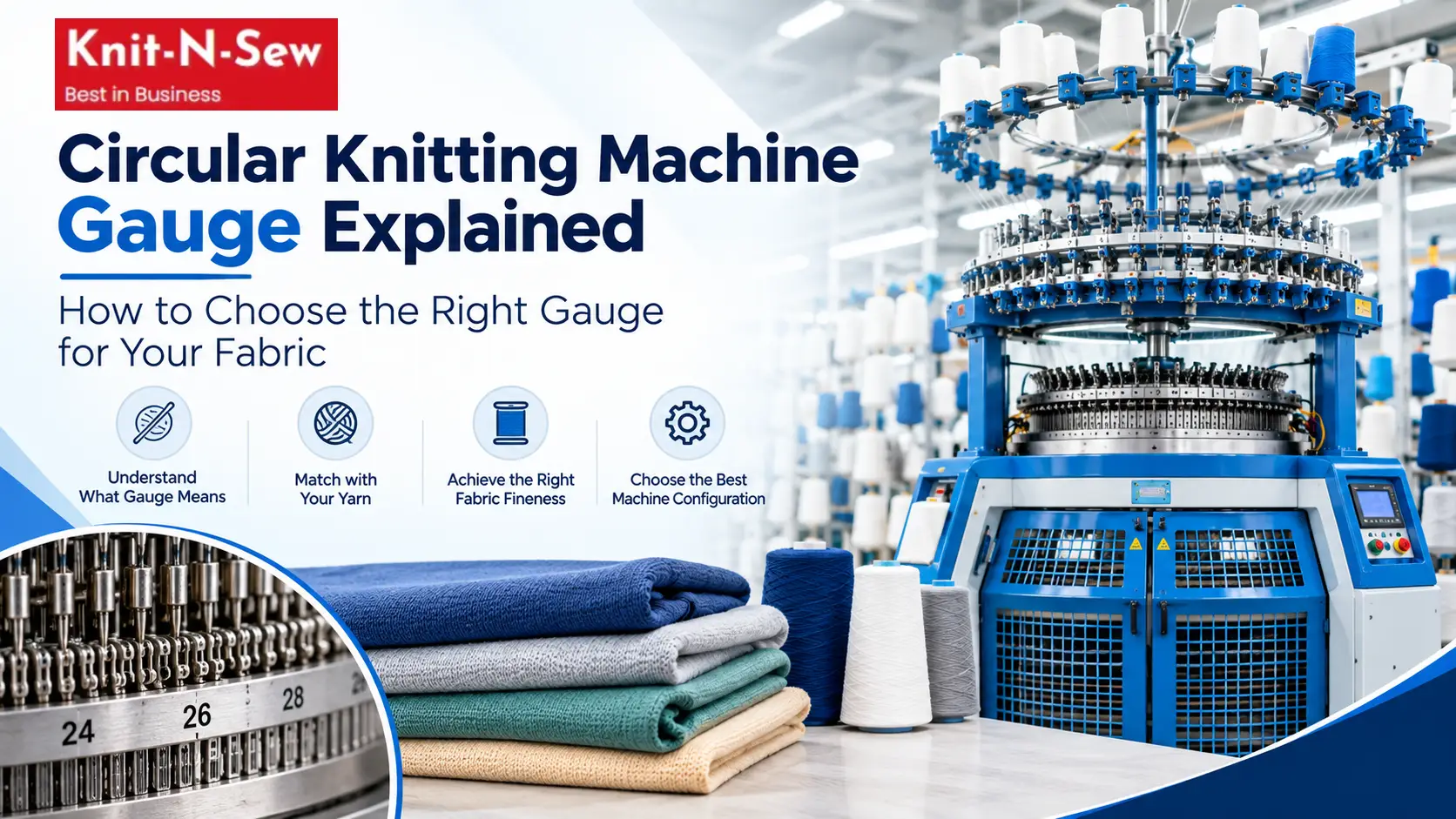
ToggleWhen selecting a circular knitting machine, understanding the circular knitting machine gauge is essential for choosing the right setup for your fabric requirements. Machine selection is not simply about comparing price, diameter, speed, or the number of feeders. Gauge determines the spacing and density of the needles used to form the knitted structure, making it an important specification to consider during the selection process.
A higher gauge generally means more needles are arranged within the same length, allowing finer loop formation, while a lower gauge has wider needle spacing and is generally associated with coarser structures. However, gauge alone does not determine the final fabric GSM, thickness, stretch, or quality. Yarn count, stitch length, fabric construction, machine type, and production settings also play important roles.
For textile manufacturers, fabric producers, and buyers investing in a circular knitting machine, understanding how gauge works can help them evaluate machine configurations more effectively and select equipment suited to their intended fabric and application.
What Is Gauge in a Circular Knitting Machine?
In circular knitting machinery, gauge refers to the number of needles per 25.4 mm (one inch) of the needle carrier when the needles are fully populated. It is commonly represented using the letter E, such as E18, E24, E28 or E32. ISO also describes gauge in terms of needle density and relates it to the pitch, or distance between adjacent needles.
In simple terms:
Higher gauge = more closely spaced needles = generally finer knitting capability
Lower gauge = more widely spaced needles = generally coarser knitting capability
For example, an E28 machine has a higher nominal needle density than an E24 machine. That does not automatically mean E28 is “better.” It means the machine is designed around a finer needle arrangement and must be matched with appropriate yarn, fabric construction and production requirements.
Why Does Circular Knitting Machine Gauge Matter?
Gauge affects the way a machine forms loops and therefore influences the structure and appearance of the fabric.
The right gauge can help manufacturers achieve the required:
- Fabric fineness
- Loop density
- Surface appearance
- Hand feel
- Fabric structure
- Yarn compatibility
- Production consistency
- End-use performance
However, it is important not to treat gauge as an isolated specification.
For example, two fabrics produced on machines with the same gauge can still have different GSM or hand feel because stitch length, yarn count, yarn composition, machine settings and fabric construction can change the final result.
This is why machine selection should start with the target fabric, rather than simply choosing the highest available gauge.
High Gauge vs Low Gauge: What Is the Difference?
The basic relationship can be understood as follows:
| Machine Gauge | Needle Arrangement | General Fabric Character |
| Lower gauge | Wider needle spacing | Coarser or more open structures |
| Medium gauge | Moderate needle spacing | Versatile fabric production |
| Higher gauge | Closer needle spacing | Finer and more refined structures |
A higher gauge generally allows finer needle spacing, but the final fabric characteristics depend on the complete knitting setup.
This distinction is especially important for manufacturers producing multiple fabric types. A machine suitable for a fine, lightweight fabric may not be the best choice for a heavier or more textured structure.
A higher gauge generally allows finer needle spacing, but the final fabric characteristics depend on the complete knitting setup.
This distinction is especially important for manufacturers producing multiple fabric types. A machine suitable for a fine, lightweight fabric may not be the best choice for a heavier or more textured structure.
Common Circular Knitting Machine Gauges
Circular knitting machines are available in a wide range of gauges depending on their design, diameter, knitting system and intended application. Industrial machines may be available from relatively coarse gauges through fine gauges, with the practical range varying by machine type and manufacturer.
Common specifications encountered in industrial knitting include gauges such as:
- 18G
- 20G
- 22G
- 24G
- 26G
- 28G
- 30G
- 32G
- 34G
- 36G
These numbers should be treated as machine specifications rather than direct fabric-GSM specifications.
The correct gauge depends on the fabric structure, yarn, machine configuration and intended application.
How to Choose the Right Circular Knitting Machine Gauge
There is no single “best” gauge for every textile manufacturer.
Instead, consider these six factors.
1. Start With the Fabric You Want to Produce
First identify the exact fabric structure and application.
Ask:
- Is it single jersey?
- Double jersey?
- Interlock?
- Rib?
- Jacquard?
- Fleece or terry?
- Sportswear fabric?
- T-shirt fabric?
- Innerwear fabric?
- Other knitted structures?
Different constructions place different requirements on the machine.
For example, single-jersey and double-jersey machines use different needle arrangements. Double-jersey machines incorporate an additional needle carrier, allowing structures such as interlock and rib to be produced.
2. Match the Gauge With the Yarn
Yarn selection is closely connected with machine gauge.
A fine-gauge machine is not automatically suitable for every fine yarn, and a coarse machine is not automatically suitable for every heavy yarn.
You should consider:
- Yarn count
- Fibre composition
- Yarn strength
- Yarn evenness
- Required fabric appearance
- Target fabric weight
- Desired hand feel
- Machine configuration
A mismatch between yarn characteristics and machine gauge can create production problems, fabric defects and inconsistent quality.
Therefore, when purchasing a machine, discuss your actual yarn specification with the machinery supplier instead of selecting a gauge only from a general chart.
3. Consider the Required Fabric Fineness
If your target is a smooth and fine knitted fabric, a higher gauge may be appropriate.
If your target requires a more pronounced structure or a heavier knitted character, a lower gauge may be more suitable.
But remember:
Higher gauge does not automatically mean higher fabric quality.
Quality depends on whether the machine configuration is appropriate for the intended fabric and whether the production process is properly controlled.
4. Consider Machine Diameter Along With Gauge
Gauge should never be evaluated independently from machine diameter.
The diameter determines the nominal size of the circular needle arrangement, while gauge determines the needle density. ISO defines nominal diameter separately from gauge and pitch.
In practical machine selection, you should therefore evaluate:
Machine type + diameter + gauge + feeder configuration + yarn + fabric construction
rather than choosing a machine based on one specification.
5. Consider Production Requirements
If the machine will be used for commercial fabric production, consider:
- Required daily output
- Fabric width
- Machine efficiency
- Number of feeders
- Operating speed
- Yarn consumption
- Changeover requirements
- Product variety
Feeder count, for example, can influence production because feeders participate in forming courses during machine operation. However, actual output depends on the complete machine configuration and operating conditions rather than feeder count alone.
6. Think About Your Future Product Range
A machinery investment should be evaluated beyond today’s order book.
If your business plans to expand into finer fabrics, sportswear, innerwear, premium T-shirts or other knitted products, consider whether the selected machine configuration will support those future requirements.
This can help reduce the need for an early machine replacement or additional investment.
Does Higher Gauge Mean Higher Quality?
No.
This is one of the most common misconceptions when comparing circular knitting machines.
Higher gauge means a greater number of needles per inch and generally supports finer needle spacing. It does not mean that the resulting fabric is automatically stronger, better, or more valuable.
For example, a coarse structured fabric may intentionally require a lower gauge. Using a much finer gauge simply because it appears more advanced could be the wrong production decision.
The correct question is:
Which gauge is suitable for my target fabric, yarn and production requirements?
That is a much better basis for machinery selection.
Gauge vs GSM: Are They the Same?
No.
Gauge and GSM are different measurements.
Gauge describes the needle arrangement of the knitting machine.
GSM means grams per square metre and describes the mass of the finished fabric per unit area.
Gauge can influence fabric structure and fineness, but it does not independently determine GSM.
Other factors such as:
- Yarn count
- Stitch length
- Fabric construction
- Yarn composition
- Knitting settings
- Finishing process
also influence the final fabric weight.
Therefore, it is incorrect to assume that a particular gauge will always produce one fixed GSM.
What Gauge Is Suitable for T-Shirt Fabric?
There is no universal gauge that is correct for every T-shirt fabric.
The appropriate specification depends on:
- T-shirt fabric construction
- Yarn count
- Required GSM
- Desired surface appearance
- Fabric stretch
- Machine type
- Production requirements
For this reason, manufacturers should not select a machine simply because a particular gauge is commonly used for T-shirts.
Instead, define the fabric first and then select the appropriate machine configuration.
What Gauge Is Suitable for Sportswear?
Sportswear can include lightweight jersey, stretch fabrics, structured fabrics and other constructions, so the required machine specification can vary significantly.
For sportswear production, consider:
Fabric structure + yarn composition + stretch requirement + GSM + gauge + machine type
For performance fabrics, the relationship between yarn, gauge, stitch length and machine settings is especially important.
What Gauge Is Suitable for Innerwear?
Innerwear often requires smooth, comfortable and consistent knitted fabrics, but the correct gauge depends on the exact fabric structure and yarn.
Fine-gauge machines can be suitable for certain fine structures, but gauge should be selected based on the actual fabric specification rather than the garment category alone.
How Gauge Affects Needles and Machine Components
Gauge is directly connected to the needle arrangement of the machine.
Because gauge defines needle spacing, the machine’s needles, cylinder, dial where applicable, sinkers and related components must be compatible with the specified machine configuration.
This is particularly important when ordering circular knitting machine spare parts, needles and sinkers.
Never order a replacement knitting needle simply by specifying the machine brand. Provide the complete machine information, including:
- Machine model
- Gauge
- Diameter
- Needle specification
- Cylinder/dial information where applicable
- Required component
This reduces the risk of receiving an incompatible component.
A Practical Checklist Before Buying a Circular Knitting Machine
Before requesting a quotation, prepare the following information:
Fabric
- Fabric type
- Structure
- Target GSM
- Finished width
- End application
Yarn
- Fibre
- Yarn count
- Yarn type
- Number of yarns
Machine
- Machine type
- Diameter
- Gauge
- Feeder configuration
- Required production capacity
Business requirement
- Expected daily production
- Current product range
- Future product plans
- Budget
- New or used machine preference
- Spare-parts and technical-support requirements
Having this information ready allows a machinery supplier to recommend a much more suitable configuration.
Common Mistakes When Choosing Machine Gauge
Choosing the highest gauge available
Higher gauge is not automatically better.
Selecting gauge based only on GSM
GSM is influenced by several variables and cannot be used alone to determine gauge.
Ignoring yarn count
The machine and yarn must be compatible.
Looking only at machine price
A cheaper machine may not be economical if it cannot produce your required fabric consistently.
Ignoring future production requirements
A machine should support your realistic product roadmap, not only your current order.
Comparing machines without comparing specifications
Always compare machines on an equivalent basis: type, diameter, gauge, feeders, speed, controls, configuration and support.
Circular Knitting Machine Gauge: Quick Answer
What is gauge in a circular knitting machine?
Gauge is the number of needles per 25.4 mm (one inch) of the fully populated needle carrier.
Is higher gauge better?
Not necessarily. Higher gauge generally means finer needle spacing. The correct gauge depends on the target fabric, yarn and machine configuration.
Does gauge determine GSM?
No. Gauge influences the knitting structure, but GSM also depends on yarn, stitch length, construction and other production parameters.
What is the difference between gauge and diameter?
Gauge describes needle density, while diameter describes the nominal diameter of the circular needle arrangement.
How do I choose the right gauge?
Start with the fabric structure, yarn specification, target GSM, end use and production requirement, then select the appropriate machine configuration.
Why Choose Knit N Sew for Circular Knitting Machine Requirements?
Choosing the right machine gauge is only one part of selecting a circular knitting machine. Textile manufacturers also need to consider machine type, diameter, knitting structure, yarn compatibility, production requirements and the availability of technical support and spare parts.
Knit N Sew Enterprises has been serving the knitting and textile machinery industry since 1998, with solutions covering circular knitting machines, flat knitting machines, used knitting machines, knitting machine spare parts, needles and sinkers.
For manufacturers in Ludhiana and across India, Knit N Sew can help evaluate machine requirements based on the fabric application rather than recommending a machine based on gauge alone. Factors such as fabric structure, yarn specification, required GSM, machine diameter, gauge and expected production can be considered together when selecting a suitable machine.
The company also deals with new and used circular knitting machines, making it possible for manufacturers to explore different machinery options according to their production requirements and investment plans.
If you are unsure which gauge or machine configuration is suitable for your fabric, share your fabric type, yarn count, target GSM, required width and production requirement with the Knit N Sew team before making a machinery decision.