
Table of Contents
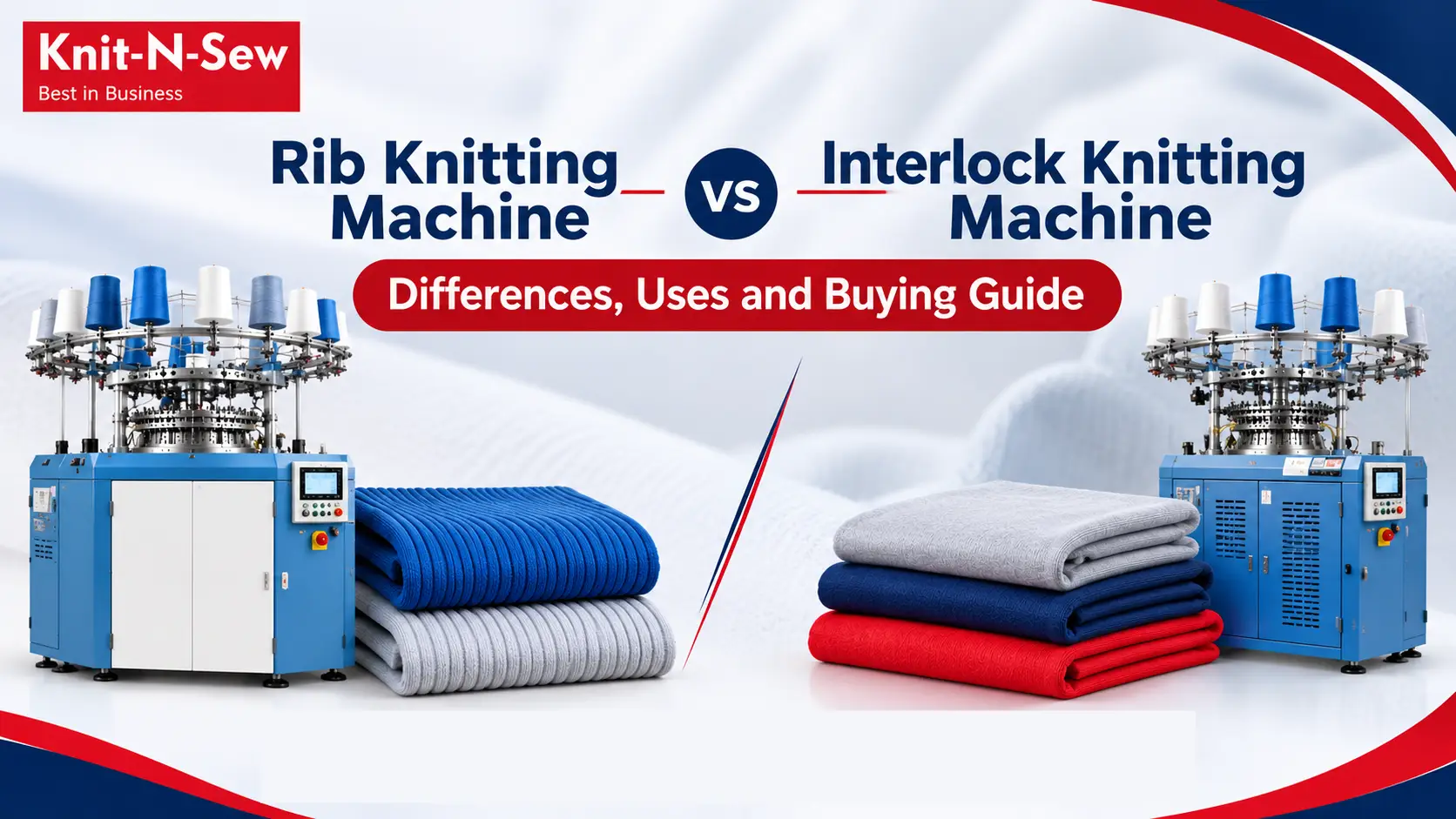
ToggleChoosing the right knitting machine is essential for achieving consistent fabric quality, production efficiency, and long-term profitability. When comparing a rib knitting machine vs interlock knitting machine, understanding their differences can help textile manufacturers make better investment decisions.
Both machines belong to the double jersey knitting category, but they produce fabrics with different structures, stretch, thickness, and applications.
The main difference is that a rib knitting machine produces stretchable fabric with visible vertical ribs, while an interlock knitting machine produces smoother, denser, and more dimensionally stable fabric.
Let’s explore their features, applications, and key buying considerations.
What Is a Rib Knitting Machine?
A rib knitting machine is a double jersey circular knitting machine that produces fabrics with alternating knit and reverse wales. It uses cylinder and dial needles arranged in an offset position to create ribbed structures.
Rib fabrics are known for their widthwise elasticity, making them suitable for garment components that require flexibility and a close fit.
Common applications include:
- T-shirt collars and neckbands
- Sweater cuffs and waistbands
- Sock tops
- Ribbed garments
- Elastic garment trims
The machine can produce various rib structures, including 1×1 and 2×2 rib, depending on its configuration.
What Is an Interlock Knitting Machine?
An interlock knitting machine is a double jersey machine designed to produce smooth, compact knitted fabrics with a similar appearance on both sides.
Unlike rib machines, interlock machines use opposing cylinder and dial needles, with alternating needle groups operating through successive feeders.
The resulting fabric generally provides better dimensional stability and coverage than basic rib fabric.
Common applications include:
- Premium T-shirts
- Babywear and children’s clothing
- Innerwear
- Sportswear
- Casual garments
Interlock fabrics are especially useful when manufacturers require a smooth surface and substantial fabric feel.
Rib Knitting Machine vs Interlock Knitting Machine: Key Differences
| Feature | Rib Knitting Machine | Interlock Knitting Machine |
| Machine type | Double jersey | Double jersey |
| Needle arrangement | Offset cylinder and dial needles | Opposing cylinder and dial needles |
| Fabric appearance | Visible vertical ribs | Smooth on both sides |
| Stretch | Generally higher widthwise stretch | Generally lower widthwise stretch |
| Fabric structure | Ribbed and elastic | Compact and stable |
| Fabric thickness | Depends on construction | Often thicker in comparable basic constructions |
| Main applications | Cuffs, collars, waistbands | T-shirts, babywear, innerwear |
| Knitting mechanism | Rib gaiting | Interlock gaiting |
In simple terms: Choose a rib knitting machine for stretch-focused ribbed fabrics and an interlock knitting machine for smooth, compact double-knit fabrics.
Which Machine Offers Better Fabric Quality and Production?
Both machines can produce high-quality fabrics, but their suitability depends on the finished product.
Fabric Stretch and Appearance
Rib fabric offers greater widthwise stretch because of its alternating knit and reverse wales. This makes it ideal for close-fitting garment components.
Interlock fabric has a compact construction with smoother surfaces and generally better dimensional stability. It is preferred for garments requiring good coverage and a structured appearance.
Production Efficiency
A conventional rib machine can form a basic rib course at one feeder, while a conventional interlock machine uses two successive feeder actions to complete its basic structure.
However, actual production capacity depends on machine RPM, number of feeders, gauge, yarn count, fabric GSM, and operating efficiency.
Therefore, manufacturers should compare actual fabric output rather than choosing machinery based only on speed.
Rib vs Interlock Knitting Machine: Which Is Better for Your Business?
Your choice should depend on the type of fabric you manufacture.
Choose a Rib Knitting Machine if:
- You manufacture cuffs, collars, and waistbands.
- Your fabric requires high widthwise stretch.
- You produce ribbed garments or knitted trims.
Choose an Interlock Knitting Machine if:
- You manufacture premium T-shirts or babywear.
- You need smooth and compact fabrics.
- Dimensional stability and fabric coverage are important.
Neither machine is universally better. The right equipment is the one that meets your fabric specifications and production targets.
Rib and Interlock Knitting Machine Price in India
The price of rib and interlock knitting machines in India depends on several factors:
- Machine brand and model
- Cylinder diameter and gauge
- Number of feeders
- New or used machine condition
- Automation and technical specifications
- Spare parts availability
Although basic rib machines may have simpler mechanisms, actual prices vary considerably by configuration and condition.
Manufacturers should evaluate maintenance costs, fabric quality, production capacity, and service support alongside the initial investment.
For available machinery options, explore Used Circular Knitting Machines at Knit N Sew.
5 Important Factors to Check Before Buying
Before investing in a rib or interlock knitting machine, consider these essential factors.
1. Fabric Requirements: Identify whether you need stretchable rib fabric or smooth interlock fabric.
2. Machine Gauge and Diameter: Select the correct circular knitting machine gauge and diameter based on yarn count, fabric width, and desired fabric characteristics.
3. Production Capacity: Compare feeder count, RPM, operating efficiency, and expected output.
4. Machine Condition: For used machinery, inspect needles, cylinder, dial, cams, and lubrication systems. Request a trial run where possible.
5. Spare Parts and Technical Support: Choose equipment with easily available knitting machine spare parts and reliable technical support to minimize production downtime.
Why Choose Knit N Sew Enterprises?
Knit N Sew Enterprises, based in Ludhiana, Punjab, supplies knitting machinery and related components for textile and hosiery manufacturers.
With industry experience dating back to 1998, the company helps buyers explore machinery options suited to their production requirements.
Whether you need a rib knitting machine for garment trims or an interlock knitting machine for smooth double-knit fabrics, selecting the correct specifications is essential.
Explore the available circular knitting machines or visit Knit N Sew Enterprises to discuss your requirements.
Frequently Asked Questions
1. What is the main difference between a rib and interlock knitting machine?
A rib knitting machine produces stretchable fabric with visible vertical ribs, while an interlock knitting machine produces smoother, more compact fabric with generally better dimensional stability.
2. Which is more stretchable, rib or interlock fabric?
Basic rib fabric generally has greater widthwise stretch than interlock fabric. Actual stretch and recovery also depend on yarn, stitch settings, and finishing.
3. Which knitting machine is better for T-shirts?
Interlock machines are suitable for smooth, substantial T-shirt fabrics, while rib machines are commonly used for T-shirt collars and neckbands. Conventional lightweight T-shirt body fabric is often produced on single jersey machines.
4. Can a rib knitting machine produce interlock fabric?
A conventional dedicated rib machine cannot automatically produce interlock fabric because the needle arrangement differs. Some specialized convertible machines may support both structures.
5. Which knitting machine is better for a small textile factory?
The best choice depends on the factory’s products. Rib machines are suitable for stretchable trims and ribbed fabrics, while interlock machines are better suited to smooth, compact double-knit fabrics.