
Table of Contents
ToggleKnitting needles are one of the most important components in modern textile manufacturing, directly influencing fabric quality, production efficiency, and machine performance. Among the most widely used options are flat knitting needles and circular knitting needles, each designed for specific knitting machines and applications. Understanding the differences between these two types(Flat knitting needles vs circular knitting needles: Compare their features, applications, benefits, and differences to choose the right knitting needle for your textile production.) helps manufacturers, garment producers, and buyers select the right solution for their production requirements, reduce machine downtime, and achieve consistent results.
In this guide, we will explain the key differences between flat knitting needles and circular knitting needles, their applications, advantages, and the factors to consider when choosing the right option for your textile manufacturing needs.
Understanding Flat Knitting Needles and Circular Knitting Needles
Flat knitting needles and circular knitting needles are essential components used in different types of knitting machines, each designed to produce specific fabric structures. Flat knitting needles are used in flat knitting machines, where the needles move back and forth in a linear motion to create flat fabric panels. These needles are ideal for producing garments with intricate patterns, shaping, and customized designs, making them widely used for sweaters, cardigans, collars, scarves, and technical textiles.
In contrast, circular knitting needles are installed in circular knitting machines, where they work continuously in a rotating motion to produce seamless tubular fabrics at high production speeds. This knitting process is commonly used for manufacturing T-shirts, socks, sportswear, hosiery, underwear, and other mass-produced garments. Since each needle type is engineered for a specific machine and knitting process, choosing the right one is crucial for achieving consistent fabric quality, efficient production, and reliable machine performance in the textile industry.
Flat Knitting Needles vs Circular Knitting Needles: Key Differences
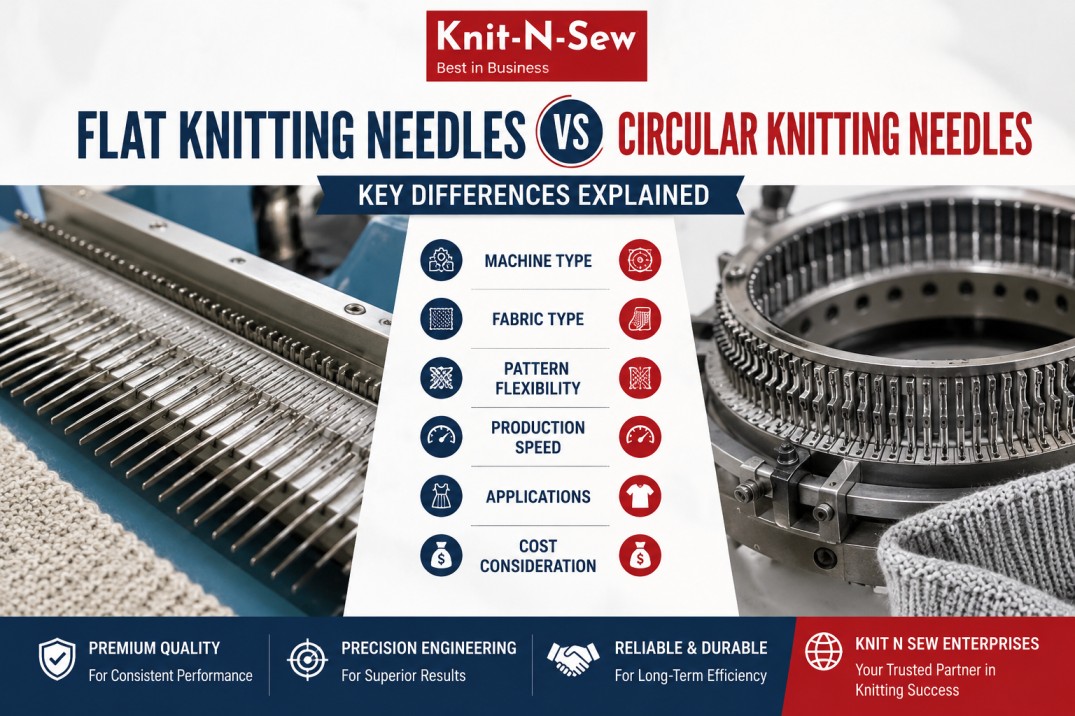
The following comparison table highlights the key differences between flat knitting needles and circular knitting needles, making it easier to evaluate their features, performance, and ideal applications.
| Feature | Flat Knitting Needles | Circular Knitting Needles |
| Machine Type | Flat knitting machine | Circular knitting machine |
| Needle Movement | Linear back-and-forth | Continuous circular rotation |
| Fabric Construction | Flat fabric panels | Seamless tubular fabric |
| Production Speed | Moderate | High-speed production |
| Design Flexibility | Excellent for complex patterns and shaping | Best for simple, continuous designs |
| Yarn Compatibility | Suitable for a wide range of yarns | Ideal for high-volume yarn processing |
| Needle Gauge Options | Available in various gauges for different applications | Wide range of gauges based on machine type |
| Maintenance | Easier inspection and replacement | More complex due to machine configuration |
| Durability | Long service life with proper maintenance | Durable for continuous production environments |
| Cost Considerations | Higher customization value | Cost-effective for mass production |
Advantages and Limitations of Each Needle Type
Both flat knitting needles and circular knitting needles offer unique benefits depending on the production process, fabric type, and machine configuration. Understanding their advantages, limitations, and ideal applications helps manufacturers select the most suitable option for achieving efficient production and consistent fabric quality.
Flat Knitting Needles
Advantages
- Excellent for creating complex patterns, shaping, and customized garment designs.
- Suitable for a wide range of yarn types and fabric structures.
- Easier to inspect, maintain, and replace, reducing machine downtime.
- Delivers high precision and consistent knitting quality.
Limitations
- Lower production speed compared to circular knitting machines.
- Primarily designed for producing flat fabric panels rather than seamless tubular fabrics.
- May require additional stitching or assembly for finished garments.
Best Suited For
Sweaters, cardigans, collars, scarves, fashion knitwear, technical textiles, and customized apparel requiring intricate designs and precise shaping.
Circular Knitting Needles
Advantages
- Supports high-speed, continuous production for large manufacturing volumes.
- Produces seamless tubular fabrics with excellent consistency.
- Ideal for mass production, helping reduce manufacturing time and costs.
- Delivers efficient performance for repetitive knitting processes.
Limitations
- Less flexible for complex garment shaping and detailed pattern work.
- Maintenance and needle replacement can be more time-consuming due to machine configuration.
- Limited to products compatible with tubular fabric construction.
Best Suited For
T-shirts, socks, sportswear, hosiery, underwear, seamless garments, and other high-volume textile products where speed and efficiency are essential.
Choosing the Right Knitting Needles for Your Production Needs
Selecting the right knitting needles requires evaluating several factors to ensure optimal performance, consistent fabric quality, and efficient production.
- Machine Compatibility: Choose needles specifically designed for your knitting machine model and specifications.
- Type of Fabric: Select needles based on whether you are producing flat panels, seamless tubular fabrics, or specialized textiles.
- Production Volume: Consider your manufacturing capacity, as different needles are suited for low, medium, or high-volume production.
- Required Fabric Quality: High-quality needles help achieve uniform stitches, smooth finishes, and minimal fabric defects.
- Pattern Complexity: For intricate designs and shaping, select needles that support precise and flexible knitting.
- Budget Considerations: Balance initial investment with long-term value, durability, and replacement costs.
- Maintenance Requirements: Opt for needles that are easy to inspect, replace, and maintain to reduce downtime.
- Long-Term Operational Efficiency: Invest in durable, precision-engineered needles that improve productivity, extend service life, and lower overall operating costs.
Also Read:- Why High-Precision Circular Knitting Machine Needles Are in Demand in 2026?
Why Needle Quality Matters in Textile Manufacturing
High-quality knitting needles play a vital role in ensuring efficient textile production and consistent product quality. Investing in precision-engineered needles offers several long-term benefits for manufacturers.
- Improves Fabric Quality: Produces uniform stitches, smooth fabric surfaces, and minimizes defects.
- Enhances Machine Performance: Ensures smooth needle movement, reducing friction and improving machine efficiency.
- Maintains Production Consistency: Delivers reliable knitting results across every production batch.
- Reduces Machine Downtime: Minimizes needle breakage and unexpected stoppages, keeping production running efficiently.
- Extends Needle Lifespan: Premium materials and precision manufacturing provide greater durability and longer service life.
- Lowers Maintenance Costs: Reduces the frequency of replacements, repairs, and machine maintenance, helping decrease overall operating expenses.
Common Mistakes to Avoid When Selecting Knitting Needles
Avoiding these common mistakes can help improve machine performance, maintain consistent fabric quality, and reduce unnecessary production costs.
- Choosing the Wrong Gauge: Using an incorrect needle gauge can affect stitch quality, fabric structure, and overall production efficiency.
- Ignoring Machine Compatibility: Always select needles that match your knitting machine’s specifications to ensure smooth operation and prevent equipment damage.
- Purchasing Low-Quality Needles: Inferior-quality needles may wear out quickly, increase the risk of breakage, and lead to inconsistent knitting results.
- Delaying Needle Replacement: Continuing to use worn or damaged needles can cause fabric defects, machine downtime, and reduced productivity.
- Overlooking Regular Maintenance: Routine inspection, cleaning, and timely maintenance help extend needle lifespan and keep knitting machines operating efficiently.
How to Select a Reliable Flat Knitting Needle Manufacturer
Choosing the right flat knitting needle manufacturer is essential for ensuring consistent product quality, reliable machine performance, and long-term production efficiency. Consider the following factors before making your decision.
- Manufacturing Expertise: Partner with a manufacturer that has extensive industry experience and a proven track record in producing flat knitting needles.
- Material Quality: Look for needles made from high-grade materials that offer excellent strength, durability, and wear resistance.
- Precision Engineering: Select a manufacturer that uses advanced manufacturing techniques to ensure accurate dimensions and consistent needle performance.
- Quality Control Standards: Choose a supplier with strict quality inspection processes to maintain product reliability and consistency.
- Customization Capabilities: If your production requires specific needle designs or specifications, ensure the manufacturer can provide customized solutions.
- Technical Support: A reliable manufacturer should offer expert guidance to help you select the right needles and resolve technical queries.
- Global Supply and Delivery: Consider suppliers with efficient logistics, timely deliveries, and the ability to serve domestic and international markets without compromising quality.
Why Choose Knit N Sew Enterprises for Knitting Needles?
Selecting the right supplier is just as important as choosing the right knitting needles. At Knit N Sew Enterprises, we are committed to delivering precision-engineered knitting needles that support efficient textile production and consistent fabric quality.
- Comprehensive Product Range: We manufacture and supply both flat knitting needles and circular knitting needles for a wide range of textile applications.
- Premium-Quality Materials: Our needles are manufactured using high-quality materials for strength, durability, and reliable performance.
- Precision Engineering: Every needle is designed for accurate dimensions and smooth machine operation.
- Consistent Quality: We follow strict quality control processes to ensure dependable performance across every batch.
- Wide Industry Applications: Our knitting needles are suitable for sweaters, hosiery, sportswear, fashion garments, technical textiles, and more.
- Customer-Focused Support: Our team helps customers select the most suitable knitting needles based on their machine specifications and production requirements.
- Reliable Supply: We focus on timely delivery and dependable service to support uninterrupted manufacturing operations.
Whether you’re looking for flat knitting needles or circular knitting needles, Knit N Sew Enterprises provides reliable solutions designed to meet the evolving needs of the textile industry.
Conclusion
Choosing the right knitting needle is essential for achieving efficient production, consistent fabric quality, and reliable machine performance. Flat knitting needles are ideal for intricate designs and shaped garments, while circular knitting needles are best suited for high-speed production of seamless fabrics. Investing in high-quality needles helps reduce downtime, extend machine life, and improve overall productivity. Knit N Sew Enterprises proudly manufactures and supplies both flat knitting needles and circular knitting needles, offering precision-engineered solutions for diverse textile applications. Contact our team today to find the right knitting needles that match your machines, production goals, and quality requirements.