Category: Uncategorized

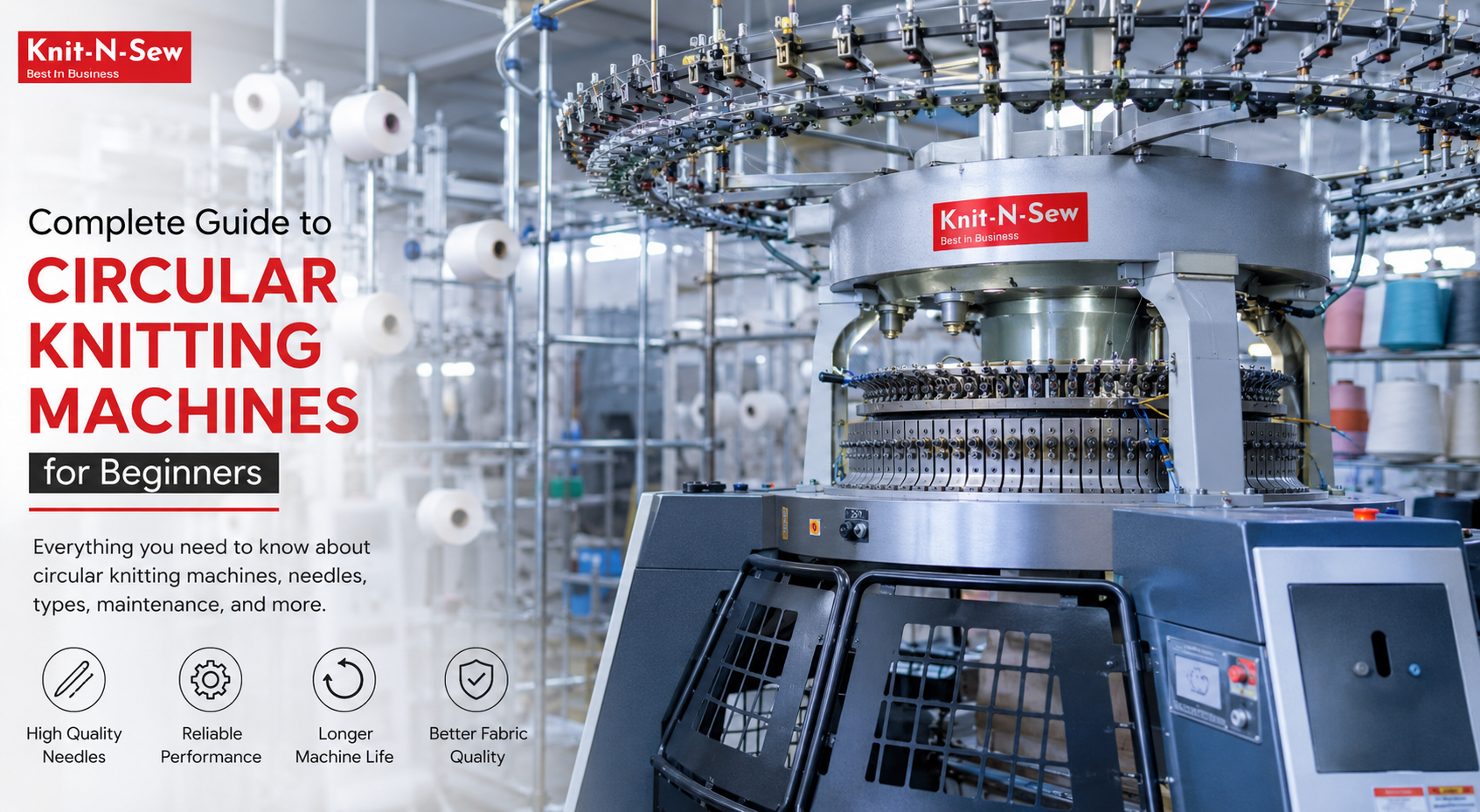
Complete Guide to Circular Knitting Machines for Beginners

Over time, the textile and hosiery sector has changed dramatically, with manufacturers being able to make high-quality materials more quickly thanks to sophisticated machinery. The circular knitting machine stands out among these inventions as one of the most crucial pieces of machinery for the manufacturing of cloth. Knowing how circular knitting machines operate will help you make wise selections, whether you’re trying to launch a knitting unit or grow your textile company.

Knit-N-Sew is a reputable brand among India for circular knitting machines manufactures  since we specialize in offering dependable knitting solutions. Beginners will learn the basics of circular knitting machines, their parts, their uses, and how to select the best machine for their requirements with the aid of this book. 

What is a Circular Knitting Machine?

A specialized textile machine called a circular knitting machine is used to create continuous tubular knitted materials. Circular knitting machines employ a circular configuration of needles fixed on a revolving cylinder, in contrast to flat knitting machines. High-speed production and effective fabric manufacture are made possible by this design.

These devices are frequently used to make textiles for:

  • T-shirts
  • Sportswear
  • Underwear
  • Socks
  • Sweaters
  • Textiles used in industry
  • Fashionable clothing

Circular knitting machines are becoming more and more in demand as textile producers look for increased productivity and reliable fabric quality. 

How Does a Circular Knitting Machine Work?

A circular knitting machine can be operated rather simply. A number of needles placed in a circular cylinder are used by the machine. Knitted cloth is produced by the needles interlocking yarn loops while the cylinder rotates.

  • The procedure entails:
  • Yarn is fed into the machine.
  • Yarn loops are formed using needles.
  • Loops are constantly interconnecting.
  • As production proceeds, the fabric is being pulled downward.

High-volume fabric production with little operator intervention is made possible by this continuous process. 

Key Components of a Circular Knitting Machine

Beginners can use and maintain the equipment more successfully if they are aware of the main components.

1. Needles

The needle system is the central component of every knitting machine. For fabric formation, stitch consistency, and overall production efficiency, high-quality circular knitting machine needles are essential.

Needles that are worn out or of poor quality might result in:

  • Defects in the fabric
  • Stitches that dropped
  • Breakage of yarn
  • Decreased output

Maintaining fabric quality requires routine needle replacement and examination. 

2. Cylinder

During operation, the cylinder, which contains the needles, rotates continually. The machine’s capacity to produce fabric is determined by varying cylinder diameters.

3. Sinkers

During the knitting process, sinkers help needles grip and release yarn loops.

4. The Yarn Feeding System

Smooth and reliable yarn supply to the needles is guaranteed by the yarn feeding mechanism.

5. The Cam System

The cam mechanism establishes stitch creation patterns and regulates needle movement. 

Types of Circular Knitting Machines

Single Jersey Circular Knitting Machines

These devices create lightweight textiles that are frequently utilized in:

  • T-shirts
  • Casual attire
  • Sportswear

Circular Double Jersey Knitting Machines

Intended to provide more durable, thicker fabrics that are appropriate for:

  • Coats
  • Sweatshirts
  • Clothes for the winter
  • Machines for Knitting Ribs

These devices create stretchy textiles that are utilized in:

  • Handcuffs
  • Collars
  • Bands around the waist
  • Knitting machines that interlock

Interlock materials are perfect for high-end clothing because of their exceptional smoothness and durability. 

Benefits of Circular Knitting Machines

High Production Speed

Circular knitting machines are perfect for commercial textile operations because they can quickly manufacture large quantities of cloth. 

Consistent Fabric Quality

Consistency in fabric and uniform stitch formation are guaranteed by cutting-edge technology. 

Cost Efficiency

Automation boosts production efficiency and lowers the need for workers. 

Versatility

Different types of yarn and fabric designs can be handled by modern machinery. 

Reduced Waste

During production, precise yarn consumption reduces material waste. 

Why Ludhiana is a Major Hub for Circular Knitting Machines

Known as India’s “hosiery capital,” Ludhiana has developed into a hub for innovative technology and textile production. Easy access to machine suppliers, replacement parts, technical support, and qualified experts is advantageous for businesses searching for a circular knitting machine in Ludhiana.

The city is a great place for firms looking for dependable knitting equipment and industry knowledge because of its robust textile ecosystem. 

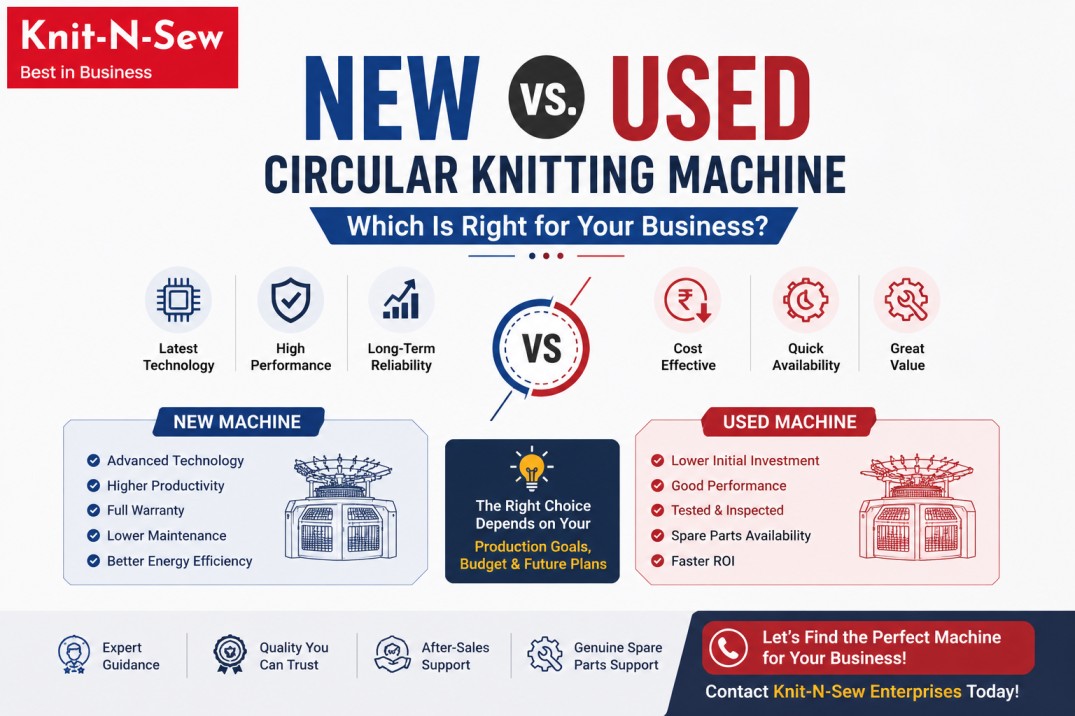
New vs Used Circular Knitting Machine: Which Should You Choose?

To lower their initial investment expenses, many startups and small-scale manufacturers think about buying a used circular knitting machine.

Benefits of Used Equipment

  • Reduced cost of buying
  • Quicker return on investment
  • Ideal for new businesses

Availability of validated machine models

  • Benefits of New Machines
  • The newest technology
  • Increased energy efficiency
  • Manufacturer’s guarantee
  • Reduced need for maintenance

Prior to buying a used machine, check:

  • state of the needle
  • Wear on cylinders
  • Age of machines
  • History of production
  • Availability of spare parts

Working with credible providers guarantees that used equipment will continue to be dependable and effective.

Importance of Machine Maintenance

Machine longevity and output quality are greatly increased by proper maintenance.

Tips for Maintenance

  • Regularly clean the machines.
  • Keep moving parts lubricated.
  • Replace any damaged needles right away.
  • Keep an eye on the yarn tension.
  • Check sinkers and cams on a regular basis.
  • Plan routine maintenance inspections.
  • Regular maintenance lowers downtime and avoids expensive repairs. 

How to Choose the Right Circular Knitting Machine

When selecting a machine, consider:

Requirements for Production

Establish the volume of productivity you anticipate each day.

Type of Fabric

Select a machine made specifically for the fabrics you plan to produce.

Diameter and Gauge of the Machine

The output and texture of the fabric are impacted by different requirements.

Availability of Spare Parts

Make sure that replacement parts, particularly circular knitting machine needles and other necessary parts, are easily accessible.

Reputation of the Supplier

Better product quality, technical assistance, and long-term dependability are guaranteed when you collaborate with seasoned circular knitting machine manufacturers. 

Why Choose Knit-N-Sew?

Knit-N-Sew is dedicated to providing top-notch knitting equipment, authentic replacement parts, and professional advice to textile makers. Our team assists companies in finding the ideal solution for their production objectives, whether they require a new machine, a used circular knitting machine, or high-end circular knitting machine needles.

We continue to assist enterprises searching for a reliable and around India thanks to our vast industry experience and robust position in the textile sector. 

Conclusion

The foundation of contemporary textile production is circular knitting machines. To achieve effective manufacturing and excellent fabric quality, it is crucial to comprehend their components, performance, and maintenance needs. Selecting the appropriate equipment can have a big impact on efficiency and profitability, regardless of whether you’re a newcomer to the textile business or an established firm looking to modernize operations.

Businesses may obtain dependable equipment, knowledgeable assistance, and long-term value that supports sustainable growth in the cutthroat textile sector by collaborating with reputable circular knitting machine manufacturers like Knit-N-Sew. 

Frequently Asked Questions (FAQs)

1. What is a circular knitting machine used for?

Tubular knitted materials for clothing like T-shirts, athletics, undergarments, socks, and fashion apparel are made using a circular knitting machine. 

2. How long do circular knitting machine needles last?

Production volume, yarn quality, and maintenance procedures all affect longevity. Maintaining fabric quality is aided by timely replacement and routine inspection. 

3. Is buying a used circular knitting machine a good investment?

Indeed, if a used circular knitting machine is properly inspected and maintained, it might be an affordable choice for startups and small textile firms. 

4. Why is Ludhiana famous for circular knitting machines?

India’s top hub for the production of textiles and hosiery, Ludhiana provides a large selection of equipment, replacement parts, trained labor, and technical assistance. 

5. How do I choose the right circular knitting machine?

Before making a purchase, take into account the kind of fabric, production capacity, machine diameter, feeder count, needle quality, availability of spare parts, and supplier reputation. 

6. How often should knitting machine needles be replaced?

To preserve the best possible manufacturing quality, needles should be changed anytime wear, bending, breakage, or fabric flaws show up. 

7. What are the benefits of purchasing from experienced circular knitting machine manufacturers?

For textile operations, reputable manufacturers offer superior machine quality, technical assistance, spare part availability, and long-term dependability. 

To know more about “Why Upgrading Knitting Machine Parts Can Increase Output Faster Than You Think” go to our previous blog.

circular knitting machine in ludhiana

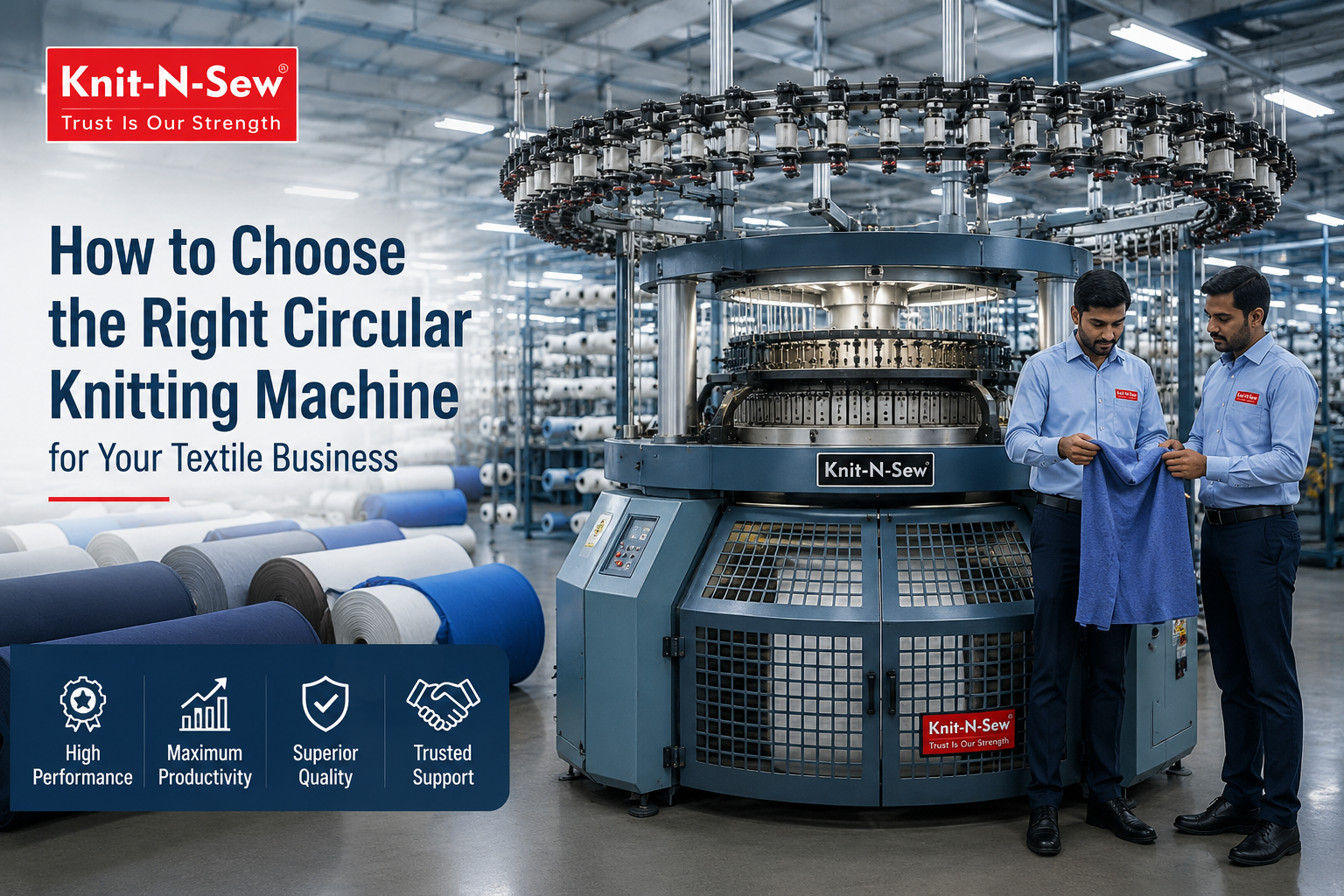
How to Choose the Right Circular Knitting Machine for Your Textile Business

Table of Contents

  1. Introduction
  2. Understanding Circular Knitting Machines
  3. Why Choosing the Right Machine Matters
  4. Factors to Consider Before Buying a Circular Knitting Machine
    • Production Requirements
    • Fabric Type
    • Machine Diameter
    • Gauge Selection
    • Speed and Productivity
    • Automation Features
    • Energy Efficiency
    • Spare Parts Availability
    • Maintenance Requirements
  5. Single Jersey vs Double Jersey Circular Knitting Machines
  6. Benefits of Investing in a Quality Circular Knitting Machine
  7. Why Ludhiana is a Leading Hub for Circular Knitting Machines
  8. How Knit-N-Sew Helps Textile Manufacturers
  9. Common Mistakes to Avoid When Buying a Circular Knitting Machine
  10. Conclusion
  11. Frequently Asked Questions

The textile industry is perpetually changing, and producers are always searching for methods to increase production output, fabric quality, and efficiency. Choosing the appropriate circular knitting machine is one of the most crucial expenditures for any textile manufacturing facility. Selecting the right equipment can have a big impact on efficiency and profitability, whether you are beginning a new textile company or modernizing your current manufacturing line.

It might be difficult to choose the best equipment because there are so many different machine models, features, and technologies on the market. Making an informed choice requires knowing your production requirements and equipment capabilities.

This guide will assist you in understanding the important aspects to take into account before making an investment if you are looking for a dependable circular knitting machine in Ludhiana

Understanding Circular Knitting Machines

A specialized textile machine called a circular knitting machine is used to create continuous tubular knitted materials. The manufacturing of clothing, athletics, undergarments, hosiery, household textiles, and technical materials all make extensive use of these machines.

Circular knitting machines, in contrast to flat knitting machines, use needles organized in a circular cylinder to produce cloth quickly and consistently.

Contemporary circular knitting machines come equipped with cutting-edge features like:

  • High-speed functioning
  • Systems for automated monitoring
  • decreased flaws in the fabric
  • Performance that uses less energy
  • Improved capacity for production

They are a crucial component of the modern textile manufacturing sector because of these benefits. 

Why Choosing the Right Machine Matters

It takes more than just buying equipment to choose the best circular knitting machine. It is about making investments in your company’s future expansion.

Using the incorrect machine can result in:

  • Reduced output
  • Higher upkeep expenses
  • Low-quality fabric
  • Frequent malfunctions in machines
  • Increased operating costs

However, the appropriate device can:

  • Boost the effectiveness of production
  • Improve the uniformity of the fabric
  • Cut down on waste
  • Boost revenue
  • Encourage the growth of your company

Therefore, it is essential to carefully consider your needs before making a purchase. 

Factors to Consider Before Buying a Circular Knitting Machine

1. Understand Your Production Requirements

Setting your production objectives is the first step.

Consider this:

  • What kind of fabric are you going to make?
  • What is your goal for everyday production?
  • Which sectors would you cater to?
  • What plans do you have for future growth?

Those that make T-shirts and casual clothing could need different machine requirements than those that make athletic or technical fabrics.

A machine should be able to handle future expansion in addition to your present production requirements. 

2. Choose the Right Fabric Type

Certain circular knitting machines are made for particular types of fabrics.

Typical fabric kinds consist of:

  • Jersey Fabric by itself
  • Jersey Fabric in Double
  • Interlocking Fabric with Ribs
  • Pique Textile
  • Fabric Fleece

The machine configuration you want will depend on your fabric requirements.

For instance:

While double jersey machines work better with thicker, more durable textiles, single jersey machines are best suited for lighter fabrics. 

3. Select the Appropriate Machine Diameter

Fabric dimensions and production output are directly impacted by machine diameter.

Typical machine dimensions are between:

  • Twenty inches
  • 24 inches
  • 28 inches
  • Thirty inches
  • 34 inches
  • 36 inches

Larger diameters are appropriate for large-scale production processes since they often yield bigger fabric volumes.

When choosing diameter, take into account:

  • Volume of production
  • Requirements for fabric width
  • Factory area that is available 

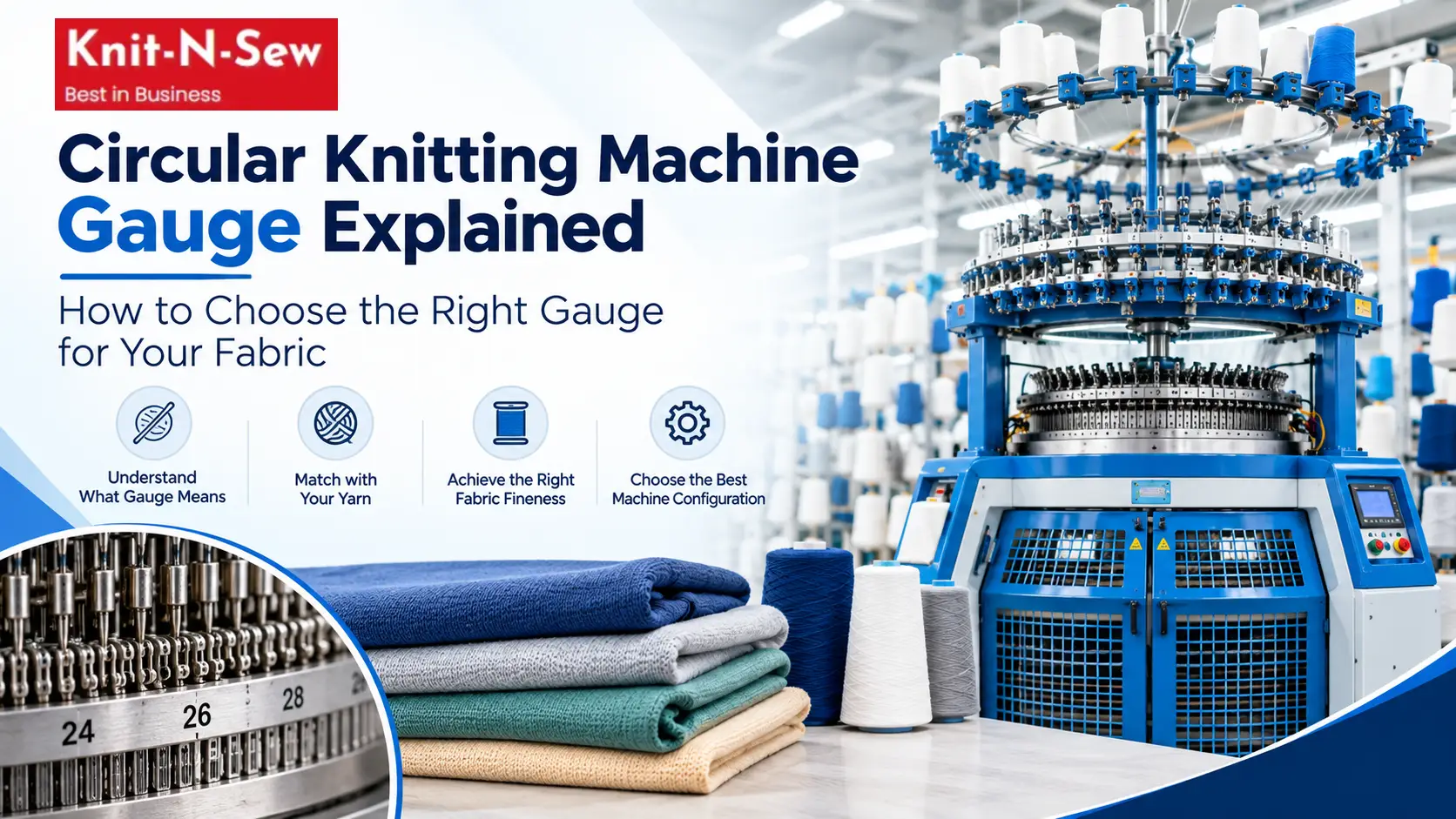
4. Understand Machine Gauge

The quantity of needles per inch is known as gauge, and it has a significant impact on the texture and quality of cloth.

For instance:

  • Lower Gauge: Coarser textiles (16G–20G)
  • Medium Gauge (24G–28G): Textiles used in general clothing
  • Higher Gauge (32G–40G): Exquisite textiles

The gauge should match the specifications of the intended product.

Inappropriate fabric structures and lower product quality can arise from choosing the incorrect gauge. 

5. Evaluate Speed and Productivity

Contemporary circular knitting machines are made to run quickly without sacrificing the uniformity of the cloth.

Examine the following while comparing machines:

  • RPM capability
  • Efficiency of production
  • Daily production of fabric
  • Frequency of downtime

Although production volume can be greatly increased by increasing speed, quality should never be sacrificed.

The best outcomes are obtained when speed and accuracy are balanced. 

6. Consider Automation Feature

The production of textiles is changing due to technology.

These days, modern machines consist of:

  • Systems for automatic lubrication
  • Detectors for yarn breaks
  • Systems for monitoring fabrics
  • Control panels that are digital
  • Software for production management
  • Automation boosts production efficiency and lowers human error.

Manufacturers can maintain their competitiveness in the expanding textile market by investing in cutting-edge technologies. 

7. Check Energy Efficiency

A large amount of the costs associated with textile manufacturing are related to energy.

A machine that uses less energy can:

  • Cut back on your use of power
  • Reduced operating expenses
  • Boost sustainability
  • Boost long-term financial success

When assessing a machine, inquire about:

  • Motor effectiveness
  • Consumption of power
  • Technologies that save energy

Energy-efficient versions frequently offer better long-term returns, despite possibly having a higher initial cost. 

8. Availability of Spare Parts

Even the most sophisticated machines need to be maintained and occasionally have parts replaced.

Make sure spare parts are easily accessible before making a purchase.

Crucial elements consist of:

  • Needles for knitting
  • Sinkers
  • Cylinders
  • Cam systems
  • Belts for feeders

Continuous production is ensured and downtime is reduced with dependable access to spare parts.

Knit-N-Sew provides high-quality knitting machine parts and accessories to effectively assist textile producers. 

9. Maintenance Requirements

Maintaining a machine is essential to its longevity and functionality.

Select a device that provides:

  • Simple access to maintenance
  • Unambiguous service standards
  • Availability of technical assistance
  • Sturdy parts

Frequent maintenance can increase overall efficiency and avoid expensive malfunctions.

Better operating efficiency is frequently achieved by a machine that requires less maintenance. 

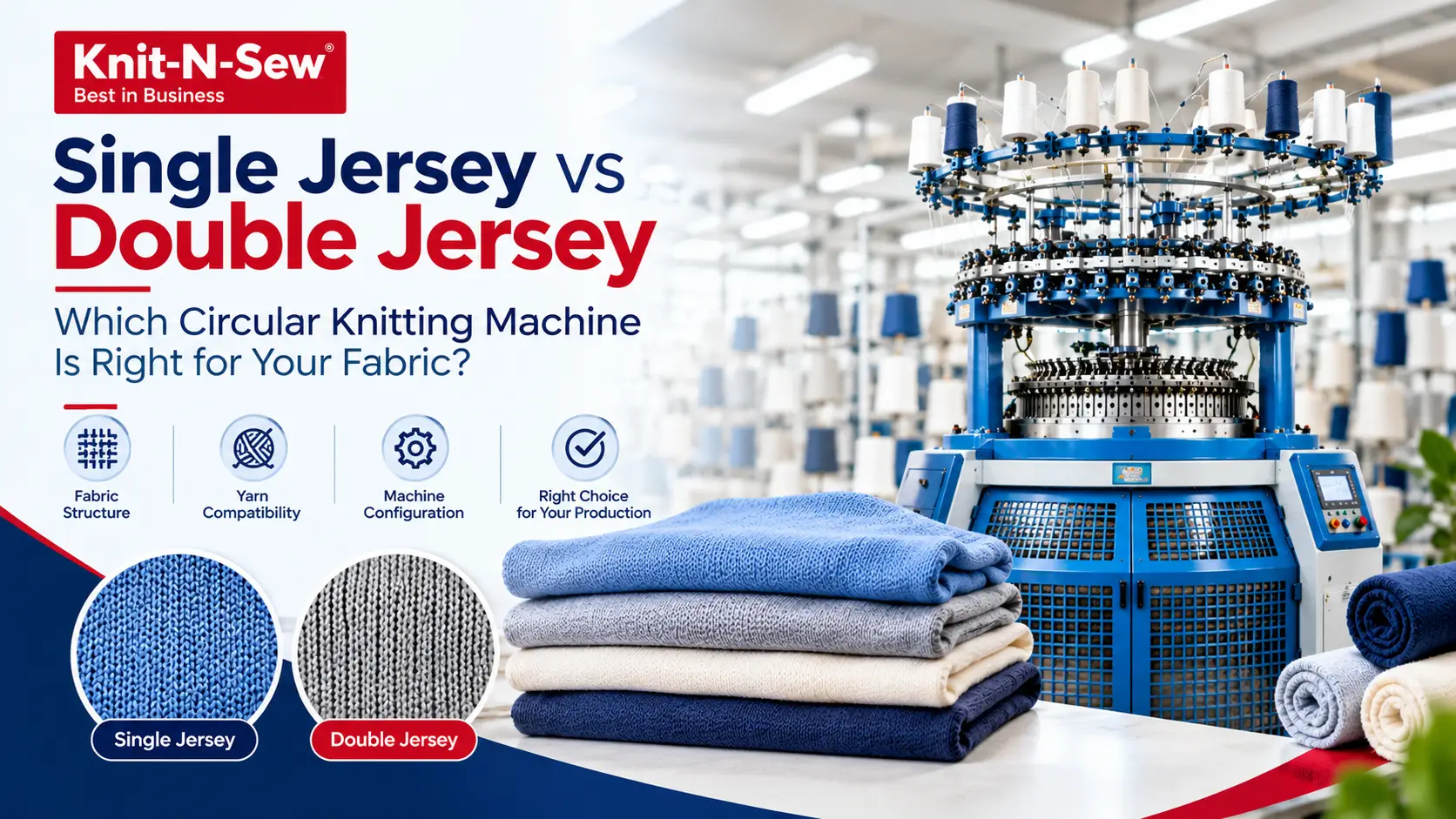
Single Jersey vs Double Jersey Circular Knitting Machines

Understanding the difference between these two machine types is essential.

FeatureSingle Jersey MachineDouble Jersey Machine
Fabric ThicknessLightMedium to Heavy
Production SpeedHigherModerate
Fabric StructureSingle LayerDouble Layer
ApplicationT-Shirts, Casual WearSportswear, Jackets
Machine ComplexityLowerHigher

Choose the machine type based on your target products and market demand.

Benefits of Investing in a Quality Circular Knitting Machine

A top-notch machine has many benefits:

Enhanced Fabric Quality:- Superior fabric durability and attractiveness are achieved through consistent stitch formation.

Enhanced Efficiency:- Large volumes of fabric can be produced in shorter manufacturing cycles thanks to advanced machinery.

Decreased Downtime:- Reliable equipment enhances operational efficiency and reduces disruptions.

Increased Return on Investment:- Premium machines frequently produce superior long-term profitability despite requiring a larger initial expenditure.

Increased Client Contentment:- Superior textiles aid producers in forging closer bonds with consumers and enhancing their reputation. 

Why Ludhiana is a Leading Hub for Circular Knitting Machines

One of India’s top hubs for textile production is Ludhiana.

The city is renowned for:

  • robust infrastructure for textiles
  • competent labor force
  • extensive network for the knitting industry
  • Simple access to equipment and replacement parts
  • Expanding prospects for exports

Businesses are looking for a dependable circular knitting machine in Ludhiana to meet their production needs as the demand for knitted clothing keeps growing.

Additionally, the area offers superior assistance for locating an industrial circular knitting machine in Ludhiana, which makes it a top choice for textile producers across India. 

How Knit-N-Sew Helps Textile Manufacturers

Knit-N-Sew is dedicated to providing high-quality machinery solutions, knitting needles, machine accessories, and technological know-how to textile businesses.

Our goal is to assist businesses:

  • Boost the effectiveness of production
  • Cut down on machine downtime
  • Obtain high-quality machine parts
  • Improve the quality of the fabric
  • Attain long-term company expansion

Knit-N-Sew provides trustworthy solutions designed to meet the demands of contemporary textile manufacturing, whether you are building a new knitting unit or modernizing your current facility. 

Common Mistakes to Avoid When Buying a Circular Knitting Machine

Many companies make expensive purchasing errors.

Steer clear of the following:

Purchasing Only Based on Cost:-The least expensive machine could lead to decreased output and increased maintenance expenses.

Ignoring Upcoming Growth

Select a machine that can accommodate expansion in the future.

Ignoring the Availability of Spare Parts

Significant manufacturing delays may result from restricted access to replacement parts.

Ignoring Technical Assistance

Long-term success depends on dependable post-purchase assistance.

Choosing the Incorrect Gauge

Fabric quality and market compatibility may be impacted by improper gauge selection.

Manufacturers can increase operational performance and optimize their investment by avoiding these errors. 

Conclusion

One of the most crucial choices for every textile production company is selecting the appropriate circular knitting machine. The perfect machine should fit your budget, future expansion plans, fabric requirements, and production objectives.

Before making a purchase, it is important to carefully consider factors including machine diameter, gauge, speed, automation, energy economy, availability of spare parts, and maintenance requirements.

Working with a seasoned industry partner may streamline the selection process and guarantee long-term success for companies looking for a reliable circular knitting machine in Ludhiana or a sophisticated industrial circular knitting machine in Ludhiana.

Through dependable knitting solutions and industry knowledge, Knit-N-Sew is committed to assisting textile producers in achieving increased productivity, superior fabric quality, and sustainable growth. 

Frequently Asked Questions (FAQs)

1. What is the purpose of a circular knitting machine?

Knitted fabrics in tubular form for clothing, sportswear, hosiery, home textiles, and industrial purposes are produced by a circular knitting machine.

2. How can I pick the best circular knitting machine?

Think about things like fabric type, production volume, machine gauge, diameter, speed, automation features, maintenance needs, and the availability of spare parts.

3. What distinguishes machines with single and double jerseys?

Double jersey machines create thicker, more structured fabrics, whilst single jersey machines create lighter fabrics.

4. What is the significance of gauge in a circular knitting machine?

Fabric quality, density, and texture are all determined by gauge. Selecting the appropriate gauge guarantees the intended fabric specifications. 

5. Why should I get a circular knitting machine in Ludhiana?

With robust industry backing, knowledgeable suppliers, competent technicians, and quick access to equipment and spare parts, Ludhiana is a significant center for the textile industry.

6. What advantages may an industrial circular knitting machine in Ludhiana offer?

High production efficiency, better fabric quality, lower operating costs, and dependable support from the regional textile ecosystem are all provided by an industrial circular knitting machine in Ludhiana. 

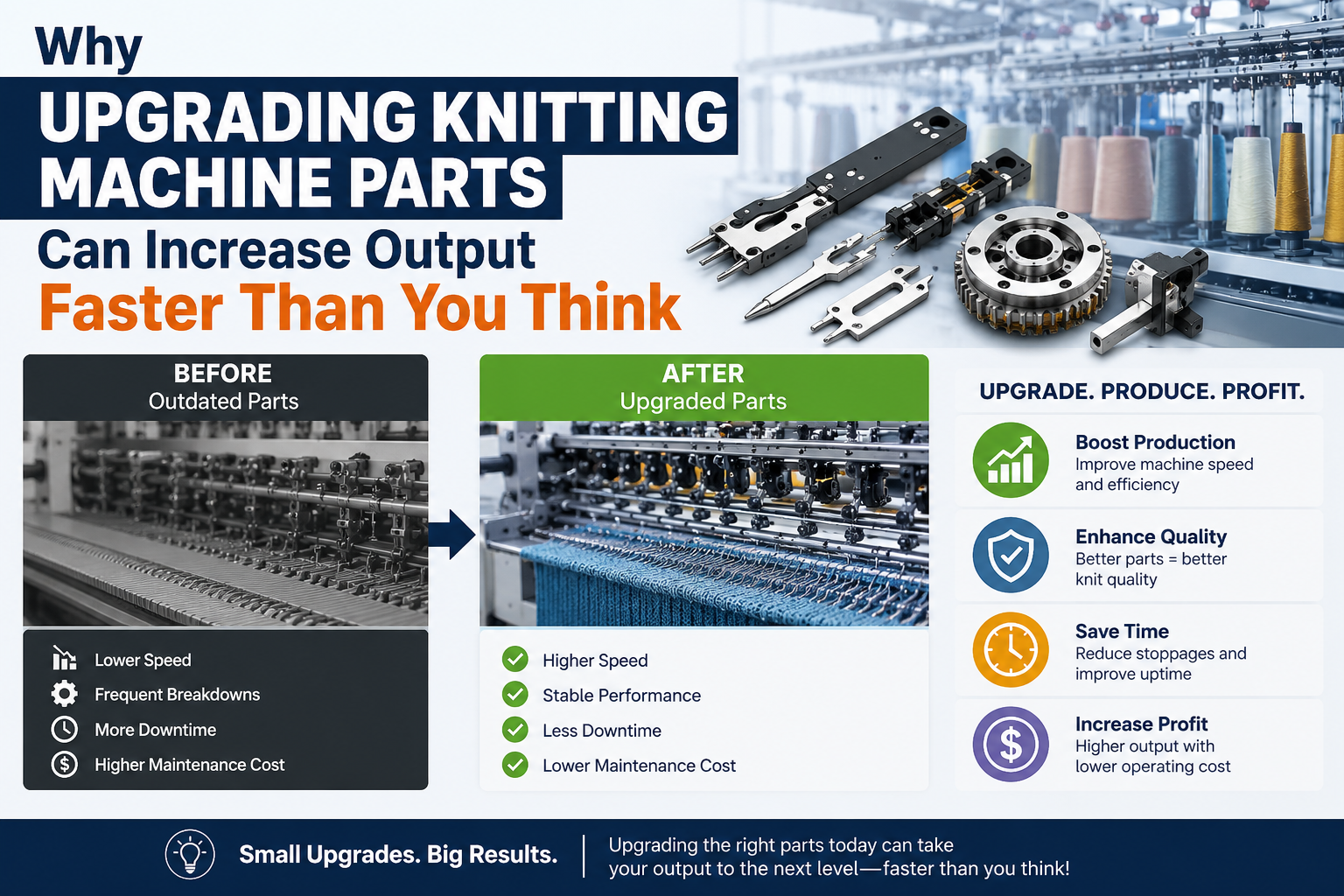
Why Upgrading Knitting Machine Parts Can Increase Output Faster Than You Think

Why Upgrading Knitting Machine Parts Can Increase Output Faster Than You Think

Production managers often wait for a total system failure before they think about their machinery’s internals. It’s a reactive habit. We see a machine running, so we assume it’s running at its peak. But the truth is, gradual wear in minor knitting machine parts can sap our efficiency by 15% or more before we even notice a drop in fabric quality.

Upgrading isn’t just about fixing what is broken. It is about closing the gap between “operational” and “optimized.”

The Real Impact of High-Quality Knitting Machine Parts on Daily Yield

When we talk about increasing output, most people think about speed. They want to turn the RPM up. But if our knitting machine parts are worn, higher speeds just mean more friction, more heat, and eventually, more needle breaks.Replacing old needles, sinkers, and selectors with premium knitting machine components allows the machine to run more smoothly at higher velocities without the risk of downtime. Friction is the enemy of the textile floor. By using components with better surface finishes, we reduce the tension on the yarn. This means fewer yarn breakages. Every time a machine stops for a yarn break, we aren’t just losing the five minutes it takes to rethread; we are losing the momentum of the entire shift.

Why Precision Knitting Machine Parts Prevent Invisible Bottlenecks

Small deviations matter. A cam that is off by a fraction of a millimeter creates uneven loops. We might not see it with the eye until the fabric hits the inspection table. At that point, we’ve already wasted meters of yarn and hours of machine time.Investing in high-grade knitting machine parts ensures that the mechanical timing remains perfect. We have seen factories increase their “A-grade” fabric yield significantly just by swapping out standard cams for precision-engineered versions. It turns a “good enough” machine into a high-performance asset.

Choosing the Right knitting machine parts for Longevity

Not all replacements are equal. Using generic spare parts for knitting machines might save a few dollars today, but they often lack the heat treatment or metallurgical integrity of the originals. They wear out faster. They create micro-vibrations.

If we are serious about knitting machine repair, we have to look at the lifespan of the part, not just the purchase price. A needle that lasts 20% longer isn’t just a part saving; it’s a labor saving. Our technicians spend less time swapping out components and more time on preventative maintenance.We’ve worked on shop floors where “ghost” errors were constant. These are those frustrating machine stops where the machine just quits for no obvious reason. There is no broken needle, no obvious jam, and no error code that makes sense. You reset the machine, it runs for ten minutes, and then it stops again. We usually find these are traced back to cheap yarn feeders that cannot handle consistent tension. It’s a nightmare for a lead technician. You spend half the shift chasing a problem that shouldn’t exist. When we switch to high-end textile machinery parts, those ghosts tend to disappear. We get a steady hum instead of a stuttering production line.

The Financial Case for Upgrading Your Knitting Machine Parts Regularly

Most floor managers treat knitting machine parts as an “if it breaks” line item. That’s a massive financial leak. Think about yarn waste. When we run old, pitted yarn guides, the friction creates micro-neps or snaps the thread entirely. That’s raw material literally going into the trash. We’ve seen production lines lose 5% of their total output simply because they wouldn’t spend a few dollars on fresh knitting machine components.Then there’s power consumption. Worn bearings or misaligned cams increase mechanical drag. The motor has to pull more current to maintain the same RPM. Over a month of 24/7 operation, that spike in our utility bill often costs more than the industrial knitting machine parts we were trying to save money on. Upgrading isn’t just about speed; it’s about efficiency. High-quality textile machinery parts pay for themselves in reduced waste and lower power draws. It’s a simple math problem that many overlook until the end-of-year audit.

Reducing Downtime Through Strategic Knitting Machine Parts Maintenance

Most downtime is avoidable. It usually stems from a component that gave several warnings before it finally snapped. If our technicians are constantly performing emergency knitting machine repair, our output is already suffering.

A proactive upgrade cycle for industrial knitting machine parts, like yarn feeders and tensioners, keeps the flow consistent. Consistency is what actually builds profit in textiles. We want the machine to run for 24 hours without a single manual intervention. That only happens when every part of the stitch-forming process is in top condition.

Modern industrial knitting machine parts are built to handle the stresses of synthetic yarns and high-tension weaves better than the stock parts from a decade ago. It’s about material science. Old components often struggle with the heat buildup from modern high-speed cycles. Upgrading these specific areas can modernize an older machine for a fraction of the cost of a new unit.At Knit N Sew, we understand that our production schedule doesn’t have room for “maybe.” We focus on providing components that do more than just fit; they perform. Our goal is to help you hit those higher output targets by ensuring your machinery is equipped with the best possible hardware. We don’t just supply parts; we supply the reliability our floor needs to actually scale.

FAQs

1. How often should we replace our knitting machine needles? 

Don’t wait for a break. If we are seeing tiny vertical lines in the fabric or feeling unusual vibration in the cylinder, the needles are already shot. In high-speed shops, we swap them on a schedule based on running hours, not just when the machine stops.

2. Can upgrading cams really increase our machine speed? 

Absolutely. If our cams are worn or poorly profiled, the needles bounce at high speeds. That bounce causes dropped stitches and mechanical “chatter.” A smooth, high-precision cam profile lets the needle follow the path without jumping, which means we can safely crank the RPM without turning the machine into a scrap pile.

3. Why should we avoid generic spare parts? 

They’re a gamble. A generic part might look identical to the OEM, but the heat treatment is usually where they cut corners. Once that part gets hot under a 24/7 load, it loses its hardness and starts galling. We save a few bucks upfront, but we’ll pay for it when that part shears off and takes out half a dozen other components with it.

4. What are the most critical knitting machine components to keep in stock? 

Beyond needles and sinkers, keep selectors and yarn feeders handy. And ceramic eyelets. People forget about those, but a single cracked eyelet will shred our yarn and ruin our yield for hours before anyone even notices the damage.

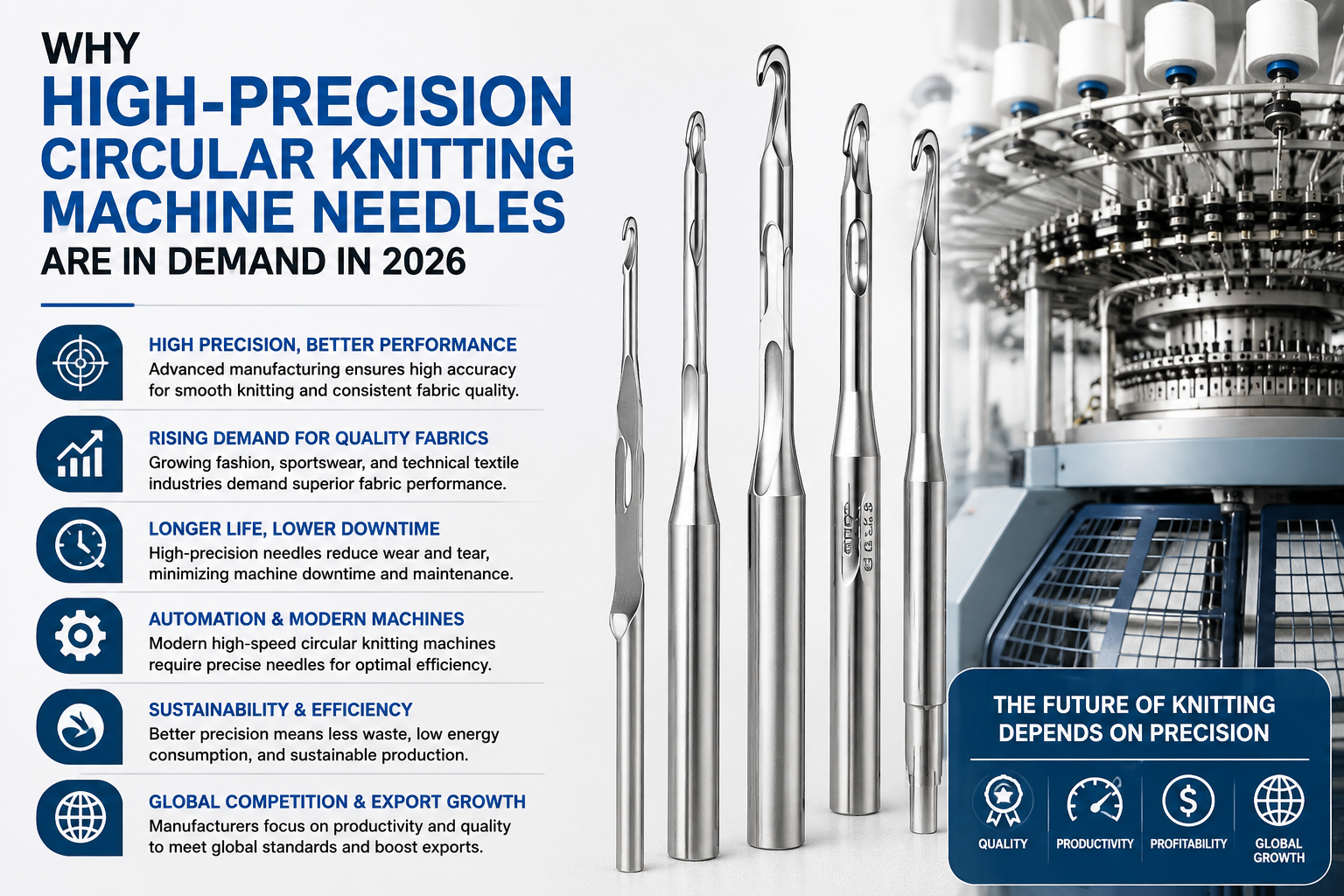
Why High-Precision Circular Knitting Machine Needles Are in Demand in 2026

Why High-Precision Circular Knitting Machine Needles Are in Demand in 2026?

Walk onto any modern factory floor today and you hear the difference. The machines run faster. Production managers are pushing cylinders to much higher RPMs just to maintain profit margins. This speed creates a massive problem with heat and friction inside the cylinder. When metal rubs against metal at these velocities without perfect alignment, components fail fast. Fabric defects happen instantly. You end up with needle lines that ruin entire rolls of fabric.

The margins for error simply do not exist anymore in textile manufacturing. Buyers in 2026 reject shipments for the smallest visual flaws. The industry has been forced to adapt.

The Demand for Precision Circular Knitting Machine Needles

Fabric trends lean heavily on fine-gauge synthetics and recycled blends right now. These yarns are incredibly abrasive. They wear down hooks and latches much faster than traditional combed cotton. High-precision circular knitting machine needles are built with exact tolerances to handle this specific friction without warping. A variance of just a few microns in the hook determines whether a machine runs for a week straight or stops every few hours for a broken latch.

Factory owners know the real math. Stopping a machine to replace a single bent component costs significantly more in lost production time than the price of premium hardware. Buying high-precision circular knitting machine needles eliminates the constant micro-stoppages that kill daily output targets. The steel composition matters immensely when the machine is pulling elastane yarns at high tension.

How Different Knitting Machine Needle Types Handle High Speeds

You cannot use the exact same setup for every fabric. We see operators try this to save money on inventory. It never works. Selecting specific knitting machine needle types based on the yarn tension and fabric structure is a hard requirement on the floor. Latch needles with conical hooks distribute stress better during high-speed knitting. Spring beard options offer a completely different loop structure for specific knits.

Using the wrong knitting machine needle types leads directly to dropped stitches. The yarn slips right off the hook when the tension peaks. The latch might close a millisecond too late. That timing issue creates a hole in the fabric that cannot be repaired. You end up cutting out yards of waste.

Selecting Circular Knitting Machine Needles for Fine Gauge Fabrics

Fine gauge knitting requires extremely thin metal profiles. The space between slots in the cylinder is minimal. Finding hardware that maintains structural integrity while being incredibly thin is difficult. The steel needs a specific tempering process. It must flex slightly under yarn tension without snapping inside the track.

Identifying Wear in Circular Knitting Machine Needles Before Failure

Operators should feel the latches during routine stops. A loose rivet indicates internal wear. Replacing them before they break inside the cylinder prevents catastrophic damage to the surrounding slots and cams. You catch the problem before it damages the machine.

Why Standard Textile Needles Break on Modern Looms

Heat buildup is the main enemy of continuous production. Standard textile needles absorb this heat and lose their temper. The metal softens over a few days of continuous running. Once that happens, the hook bends outward from the constant pull of the yarn.

High-precision textile needles feature modified friction zones. They displace the heat instead of absorbing it. This keeps the hook rigid even after millions of loop formations. You can literally see the difference in the fabric surface. The loops look identical across the entire width of the roll. The fabric weight remains consistent from the start of the batch to the finish.

Upgrading to Circular Knitting Needles Industrial Specifications

A domestic or sample machine operates under completely different stress loads than factory equipment. The push toward circular knitting needles industrial standards is really about predictability. Mill owners need to know exactly how many hours a part will last before they schedule maintenance. Unplanned downtime destroys delivery schedules and upsets buyers.

When you install circular knitting needles industrial grade parts, the latches open and close with exact timing. The yarn clears the spoon cleanly every single time. There is no guessing if the machine will make it through the night shift. You turn it on and let it run.

The Hidden Cost of Budget Knitting Spare Parts

cheapest supplier. This creates nightmares on the production floor. Cheap knitting spare parts have inconsistent dimensions. One batch fits the cylinder perfectly. The next batch is too tight and causes the entire machine to seize up. It puts massive strain on the drive motor.

Sourcing reliable knitting spare parts eliminates these variables entirely. You get consistent cam wear and predictable yarn tension across all your machines. The mechanics spend less time tuning the dials and more time actually running the production orders. It protects the expensive elements of your machine like the cylinder walls and sinker rings. When sinkers and needles interact smoothly, the fabric comes out flawless.

Practical Needle Maintenance Textile Routines for 2026

You can buy the best hardware in the world and still ruin it with bad maintenance. The fluff from cotton and the fine dust from recycled polyester pack tightly into the slots. Good needle maintenance textile routines require high-pressure air and specialized flushing oils to push this debris out before it solidifies. Using the wrong oil viscosity just turns that dust into a thick paste.

If the slots get clogged, the parts cannot slide freely. They stick. The cams hit the butts at the wrong angle and snap them off completely. Proper needle maintenance textile schedules dictate cleaning cycles based on yarn type rather than time on the calendar. Running heavy spun yarns requires flushing twice as often as running smooth filament polyester.

Getting your production line up to modern standards takes more than just buying new yarn. The hardware inside the cylinder dictates the final quality of the fabric you ship to buyers. Finding components that actually match the speed and tension of your specific machines removes the guesswork from your daily operations. For mills looking to eliminate fabric defects and keep their cylinders turning without unexpected stops, upgrading your hardware through knitnsew.in provides the reliability required to stay competitive in today’s demanding textile market.

FAQs

What causes vertical lines in knitted fabric?

A bent hook or a stiff latch creates uneven loops during the knitting process. This shows up as a continuous vertical line down the fabric roll. Replacing the damaged component immediately solves the issue.

How often should we oil the knitting cylinder?

Lubrication depends heavily on machine speed and yarn type. Most high-speed industrial machines require continuous automatic lubrication with specific viscosity oils to prevent the metal components from overheating and seizing.

Can we use one needle setup for all fabrics?

No. Different yarns require specific hook shapes and latch sizes. Matching the hardware to the yarn prevents dropped stitches and extends the life of the cylinder slots.

Why do latches break off during production?

Latches usually break due to metal fatigue from high-speed impact or because dirt accumulation in the slot forces the latch to close at an unnatural angle against the cam.

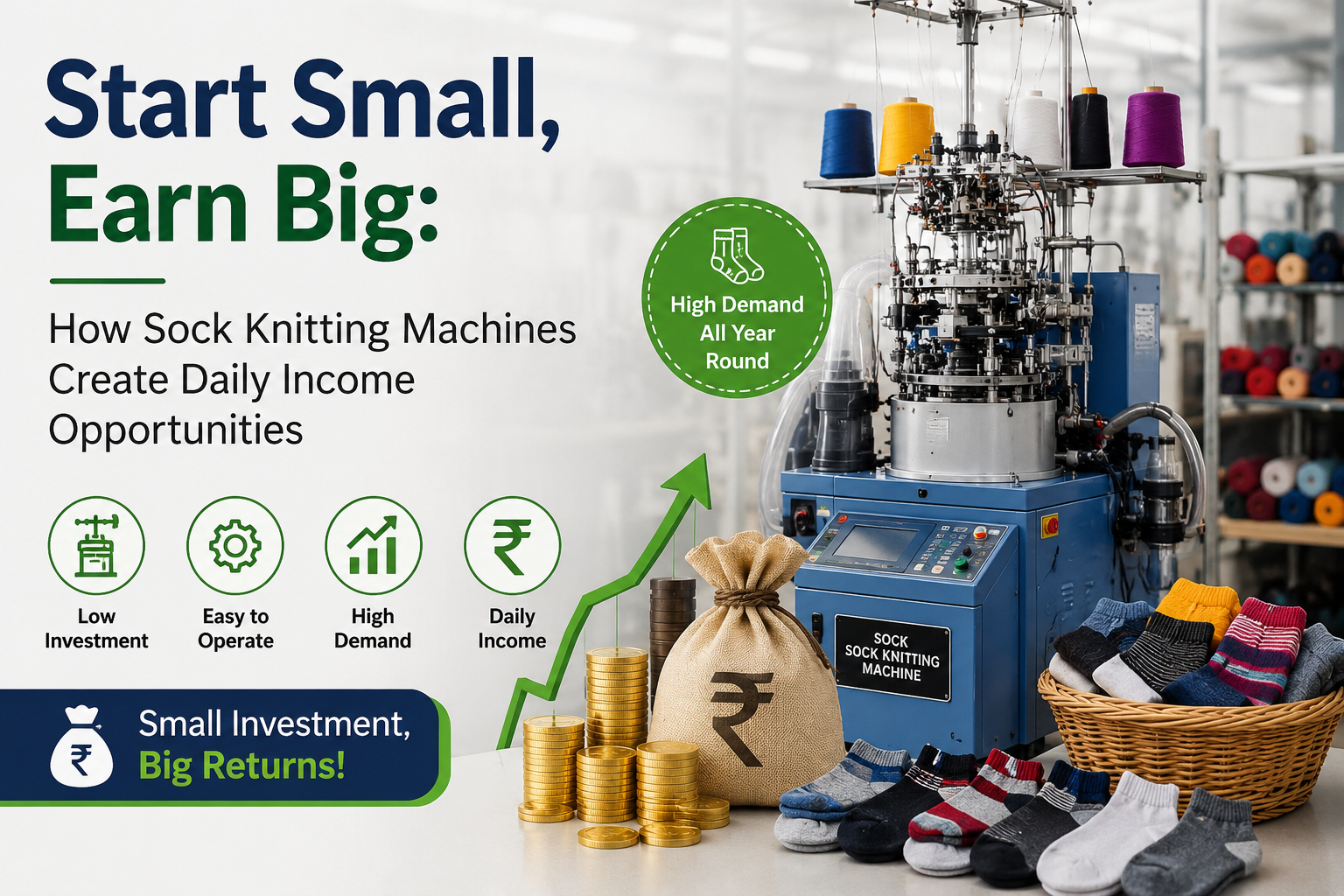
Start small earn big

Start Small, Earn Big: How Sock Knitting Machines Create Daily Income Opportunities

Manufacturing usually requires massive capital. At least that’s what people believe.

People assume they need acres of factory space and dozens of workers to make money in the apparel industry. That is false. There is a specific niche that works in a standard 10×10 room. Socks. Every person wears them. They wear out quickly. Retailers constantly need fresh stock. You can supply that demand directly from a small workspace.

The Daily Economics of a Sock Knitting Machine

Let us look at the actual numbers. A standard setup produces dozens of pairs per hour. You buy yarn in bulk. You feed it into the equipment. The output is a finished product ready for packaging. Local markets pay cash for daily deliveries. This creates an immediate revenue cycle. You do not wait 90 days for payments. Shop owners buy inventory weekly.

Talk to wholesalers in your city. They move thousands of pairs a week. If you can supply fifty dozen pairs of consistent quality, they will buy from you. The margins are thin at the wholesale level. The volume makes up for it. Retail direct gives you better margins but requires more legwork on the streets.

Choosing the best sock knitting machine for small business operations changes how you manage overhead. You do not need five operators to start. One person manages multiple units. This keeps labor costs near zero during the initial phase. You turn it on. You watch the tension. You collect the finished pieces.

Why the Automatic Sock Knitting Machine Changes the Game

Older equipment required constant manual intervention. A thread breaks and production stops. You lose an hour fixing it. An automatic sock knitting machine handles tension control and pattern switching without you touching the dials. You load the digital file. The equipment reads it and starts working.

We see operators running these units from their garages successfully. They program a school uniform pattern on Monday. On Wednesday they switch to ankle socks for retail shops. It takes five minutes to change the production run. The versatility is what keeps the cash flowing. If one product stops selling, you immediately manufacture something else.

Operating a Computerized Sock Knitting Machine at Home

Software controls the needles. A computerized sock knitting machine takes a digital design and turns it into physical fabric. You connect a USB drive or transfer the file directly through a cable. The interface shows you exactly how much yarn remains. It alerts you before a spool runs dry.

This precision eliminates waste. Bad stitches cost money. You throw away defective pairs and lose your profit margin on that raw material. Computerized controls keep the defect rate below one percent. You get consistent sizing on every single pair.

Analyzing the Sock Knitting Machine Price in India

Capital is the biggest hurdle for new manufacturers. You need to know exactly what this costs upfront. The sock knitting machine price in India varies based on needle count and motor capacity. Basic models start lower. High-speed units cost more. You also need to budget for the toe-closing equipment and the boarding machine. These secondary tools shape and finish the product for retail display.

Do not just look at the sticker price. Calculate the payback period. If a unit makes 300 pairs a day and your profit is a few rupees per pair, you can map out your break-even point. Most dedicated operators clear their initial investment within eight to twelve months. They work the local markets hard to guarantee daily sales.

Scaling from One Industrial Sock Knitting Machine to a Fleet

Starting small limits your financial risk. You buy one unit. You secure three local buyers. Once those buyers ask for more volume, you add a second unit. An industrial sock knitting machine runs 24 hours a day if you maintain it properly. They are built for continuous use in harsh environments.

You grease the bearings. You clear the lint. The equipment keeps running. When you have three or four units running simultaneously, your power consumption increases but your output multiplies drastically. This is how a small setup transitions into a real factory. The hardware handles the workload while you focus on finding more buyers.

Picking the Best Sock Knitting Machine for Small Business Growth

Buyers often get confused by technical specifications. Should you buy 144 needles or 168 needles? Terry or plain? The best sock knitting machine for small business owners is the one that matches local market demand. Visit the shops in your town. Look at what they actually sell. If they sell thick winter socks, buy a machine built for terry loops. If they sell thin formal wear, get a higher needle count.

Consider the physical footprint. These units are compact but they vibrate. You need a solid concrete floor. You also need space for the air compressor. The pneumatic systems require steady air pressure to fire the yarn cutters.

Do not overcomplicate the purchase. Get a computerized sock knitting machine with local service support. Parts wear out eventually. Needles break during heavy runs. You need replacement parts fast. Downtime kills daily income. Buying equipment with no local technician is a massive financial risk.

Maximizing Your Output and Daily Profit

Efficiency defines your final profit margin. Keep your workspace organized. Store yarn right next to the automatic sock knitting machine. When a spool finishes, you should replace it in seconds. Buy quality raw materials instead of the cheapest options. Cheap yarn breaks frequently. Every thread break stops the industrial sock knitting machine dead.

A continuous run generates maximum profit. You want the equipment humming from morning until night. Sort the finished socks immediately. Link the toes. Press them flat. Pack them by the dozen. Have them ready for the morning delivery route.

The sock knitting machine price in India makes this business accessible for serious entrepreneurs who want to manufacture real physical goods. You control the manufacturing. You control the sales. The market never stops buying socks. People lose them, wear holes in them, and buy more. Make sure your business has the right foundation and the right hardware. Explore the equipment options available at knitnsew.in to start your production line today.

Frequently Asked Questions

What is the power requirement for a sock knitting machine?

Most standard units run on single-phase or three-phase power depending on the exact model. A typical machine consumes between 1.5 kW and 2 kW per hour. You can easily run a small setup on a standard commercial electrical connection without needing an industrial grid upgrade.

Do I need specialized training to operate the equipment?

The hardware is highly automated. You need to learn how to thread the yarn, load the digital patterns, and perform basic daily maintenance like oiling and lint removal. Most suppliers provide an initial training session. It takes a few weeks of hands-on practice to get comfortable troubleshooting minor stops.

How many pairs can a machine produce daily?

Output depends entirely on the design complexity and the size of the sock. A standard plain sock takes about two to three minutes to knit. Running a 10-hour shift yields roughly 250 to 300 pairs. Terry socks take slightly longer due to the thicker weave pattern.

circular knitting machine spare parts

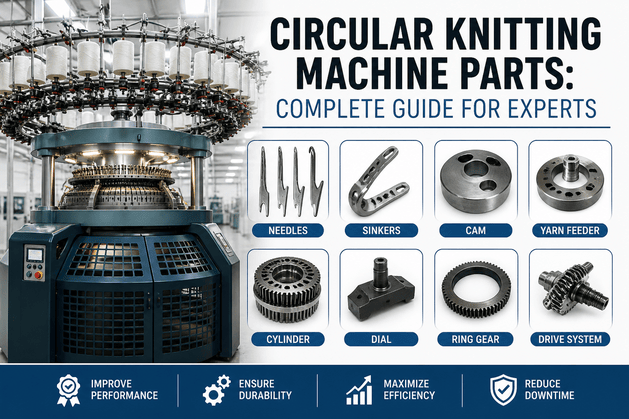
Circular Knitting Machine Parts: Complete Guide for Experts

Running a high-speed production floor reveals the harsh realities of mechanical wear. A single damaged needle creates hundreds of meters of defective fabric before the operator catches it. Finding the correct circular knitting machine parts requires knowing what actually breaks on the floor. Theoretical knowledge from a manual does not help when your machines are dropping stitches at 30 RPM. You need to understand the physical stresses applied to the metal.

The Core textile machine components That Drive Production

The cylinder holds the entire operation together. This large, grooved metal base dictates the gauge and diameter of your fabric. Cylinders are machined from specialized steel alloys with incredibly tight tolerances. We have seen cylinders warp from improper handling during a changeover. When that happens, the entire machine becomes useless.

Cams dictate the path of the needles. They wear out unevenly based on your most frequent stitch patterns. A knit cam takes more physical impact than a miss cam because it forces the needle to clear the old loop and form a new one. You must inspect cam tracks for micro-abrasions. Replacing these textile machine components requires precision calibration. You cannot just swap a cam and restart the motor. The clearance between the cam and the needle butt must be exact.

Understanding circular knitting machine parts and Wear

Needles and sinkers take the most abuse. They run at high temperatures. They constantly rub against synthetic or natural yarns. Lint management is a continuous battle in this zone. Cotton yarns shed short fibers. These fibers mix with the needle oil to create a dense sludge. If you do not clean this sludge, it hardens and pushes the needles outward.

Examining Primary circular knitting machine parts

Consider the needle latch. The latch opens and closes thousands of times a minute. The rivet holding the latch eventually wears out. When the latch becomes loose, it catches the yarn incorrectly and creates a defect in the fabric roll. Sinkers control the fabric loop during the stitch formation. If the sinker throat develops a groove from abrasive polyester yarns, the loop size will vary across the fabric width.

Extending the Life of Circular Knitting Machine Parts

Monitor your yarn tension constantly. High tension snaps needles. Low tension causes dropped stitches. Adjust the central stitch control based on the specific yarn batch you are running. Different dye lots of the same yarn often require tension adjustments.

Sourcing Reliable knitting machine spare parts

Downtime costs money. Waiting three weeks for a specific dial cam eats into your profit margins. Mill managers often try to save money by purchasing generic knitting machine spare parts. We advise against this practice entirely. Generic sinkers often have rough edges left over from the stamping process. Those rough edges cut delicate cotton yarns. Stick to exact specifications for your specific machine brand. The upfront cost is higher. The operational reliability makes up for that cost in a matter of days.

Essential circular knitting machine accessories for Optimal Output

Accessories do not interact directly with the yarn loop. They control the environment around the machine. Positive yarn feeders ensure consistent tension from the creel to the needles. If a feeder slips, the fabric weight changes immediately.

Creels hold the yarn cones away from the immediate knitting zone. Side creels save space on the floor. Overhead creels reduce lint accumulation on the cones themselves. Investing in good circular knitting machine accessories prevents feeding errors before the yarn even reaches the cylinder. Fabric spreaders and take-down rollers also fall into this category. If the take-down tension is uneven, the fabric roll will telescope.

Implementing Strict knitting machine maintenance

Continuous oil lubrication keeps these machines functioning. Running at high speeds generates massive heat inside the cylinder. Automatic oilers must be checked daily. You must use the correct oil viscosity. Using oil that is too thick causes needle stickiness. Using oil that is too thin fails to protect the metal from friction. We once walked onto a floor where a clogged oil line caused the needle butts to fuse to the cam track. The repair took four days and ruined a production run.

Proper knitting machine maintenance involves removing lint from the cylinder grooves every single shift.

Here is a basic checklist operators should follow on the floor:

  • Check the automatic oiler reservoir level visually.
  • Inspect yarn carrier tips for physical grooves caused by yarn friction.
  • Use an air hose to blow lint out of the sinker ring. Do this carefully so you do not drive the lint deeper into the cam tracks, where it will bind the needles.

Specifics of hosiery machine parts

Sock manufacturing uses a much smaller cylinder diameter. The mechanical principles remain identical to large scale body size machines. The components are simply packed more tightly. You have select jacks and pattern actuators crammed into a four-inch cylinder space.

Handling hosiery machine parts requires specialized tools and patience. A bent selector jack in a sock machine ruins the heel pouch construction. The timing on these small machines is incredibly tight. A misalignment of a millimeter causes the yarn to miss the needle hook entirely. You cannot force components into place on a hosiery machine.

Managing a textile floor means managing friction, heat, and tension. You have to keep detailed logs of part replacements. If you notice needles breaking in the exact same slot every week you have a damaged cylinder wall. Pay attention to the physical signs your equipment gives you. Maintain your equipment with precision.

FAQs

When do we actually swap out knitting machine spare parts?

People always ask for a timeline. The manual says three to six months for needles. The real answer depends on your yarn. Running cheap polyester means you might need a swap in eight weeks. Cams last longer. You still have to physically check the tracks for scoring. Waiting for the fabric to show defects means you waited too long.

Which textile machine components fail the fastest?

Sinkers take a beating. Needles snap constantly due to friction. Yarn carriers get tiny grooves cut into them from the yarn passing through at high speeds. Once that groove forms, the tension gets completely erratic. Catching that early saves a massive amount of waste.

What happens if we skip daily knitting machine maintenance?

Cotton sheds short fibers. That lint mixes with the needle oil and forms a paste. It turns into cement inside the cylinder grooves if left alone. Blowing out the sinker ring has to happen every single shift. Do not skip this.

Can we use standard parts on sock machines?

Most people try to adapt standard components. Hosiery machine parts have a completely different scale and needle butt angle. It never works. You will just destroy the pattern actuators inside the small cylinder.

Spotting worn circular knitting machine parts early?

Look directly at the fabric coming off the take-down rollers. Do not wait for the quality control room to flag a roll. Vertical lines mean you have a sinker problem or a damaged needle hook. Stop the motor and pull the damaged component right then. Finding exact replacements for these machines dictates your uptime. You cannot run a profitable floor waiting on unreliable shipments. Sourcing your components through us at Knit n Sew (knitnsew.in) gives you the exact specifications required for continuous high-speed production.

Why Sinker Jacquard Machines Are Revolutionizing Pattern Knitting

Why Sinker Jacquard Machines Are Revolutionizing Pattern Knitting

If you run a textile unit in India, you already know plain fabrics don’t sell the way they used to. Buyers want texture, colour combinations, and designs that stand out. And if you’ve been chasing those results with older cam-driven setups, you’ve probably felt the gap between what your machines can do and what the market demands.

That gap is where sinker jacquard technology steps in. Over the past few years, these systems have quietly changed how manufacturers in Ludhiana, Tiruppur, and Surat approach patterned knit fabrics, and the results speak for themselves.

How a Jacquard Knitting Machine Creates Patterns

A jacquard knitting machine uses individual needle selection to create patterns during the knitting process itself. Each needle can be independently controlled to knit, tuck, or miss a stitch, so you can program anything from simple stripes to complex multi-colour motifs without swapping mechanical parts.

In sinker jacquard systems, the sinker (a thin metal plate between adjacent needles) does more than hold fabric down while needles rise. It actively controls loop formation and stitch tension. When each sinker is electronically controlled, you get stitch-by-stitch precision that fixed-cam systems can’t match. The practical result is sharper colour boundaries, fewer floats, and a noticeably cleaner fabric face.

On a standard machine, sinkers follow a fixed path. They all move the same way at the same time, which is fine for plain single jersey but becomes a bottleneck the moment you need pattern variation within a single course. Electronic sinker selection removes that limitation entirely, and that is why sinker jacquard machines are revolutionizing pattern knitting across the Indian textile industry.

What Makes the Best Electronic Jacquard Worth the Investment

Not all electronic jacquard systems are built the same. Some manufacturers bolt a basic selector onto an older mechanical frame and call it “computerised.” Those machines usually run slower, break down more often, and limit your pattern repeat size.

The best electronic jacquard systems share a few traits. Selection speed keeps up with 25+ RPM. The software reads standard design formats like BMP or PAT files without proprietary conversion. And the hardware handles continuous production without overheating.

When you’re shopping for the best electronic jacquard, look beyond the brochure. Ask about pattern repeat capacity, colour-per-course limits, local spare parts availability, and 24-hour service support. In a market where downtime costs real money, those details matter more than any spec sheet.

Why the Circular Jacquard Knitting Machine Dominates Production

The circular jacquard knitting machine is the workhorse behind most patterned knit fabric produced globally. Running at 28 RPM with 72 feeders, a well-maintained circular jacquard knitting machine produces fabric at speeds flat-bed machines can’t touch. And because fabric comes off as a continuous tube, you skip the selvedge waste that plagues flat knitting.

Single jersey jacquard covers about 70 percent of Indian production needs, ideal for T-shirts, activewear, and innerwear. Double jersey jacquard, using both cylinder and dial, creates thicker reversible fabric for outerwear and technical textiles. That 30 percent of double jersey work is usually the higher-margin business.

Design changes on a computerised circular jacquard knitting machine take minutes instead of hours. Load a pattern file from USB, the machine maps it to needle positions, and you’re running the new design before your chai gets cold. Some systems even preview patterns on-screen so you catch errors before they become 200 metres of wasted fabric.

How a High Speed Electronic Jacquard Machine Pays for Itself

Speed is money in knitting. A high speed electronic jacquard machine uses piezo-electric or spring-return selectors that respond faster than older solenoid systems, maintaining 30+ RPM even on complex multi-colour patterns.

Here are rough numbers: upgrading from a mechanical jacquard at 18 RPM (about 120 kg per shift) to a high speed electronic jacquard machine at 30 RPM can push output to 190 or 200 kg per shift. That is 60 to 70 percent more fabric from the same floor space and the same operator. Factor in faster pattern changes and lower defect rates, and the payback period for most units falls between 18 and 30 months.

Speed does put more stress on parts. Sinkers and needles wear faster, and electronic selectors need periodic inspection. But a solid maintenance routine (daily oiling, weekly sinker checks, monthly electronics review) keeps a high speed electronic jacquard machine running smoothly for years.

Why Sinker Jacquard Machines Are Revolutionizing Pattern Knitting in India

Previous machine upgrades mostly improved speed or reduced labour. Sinker jacquard changes what you can actually make. Patterns that once required expensive imports can now be produced locally. Designs previously limited to slow flat-bed machines can be approximated on fast circular setups.

If you’re considering this upgrade, the machine is only half the equation. You need a supplier who understands the technology well enough to match the right configuration to your products.

That is what Knit N Sew has been doing since 1998. Based in Ludhiana, Knit N Sew supplies new and pre-owned circular knitting machines along with needles, sinkers, spare parts, and hands-on technical support. Whether you need a jacquard knitting machine for the first time or you’re upgrading from an older model, their team can match you with the right equipment. Reach them at (+91) 9814177799 or visit knitnsew.in.

Why Sinker Jacquard Machines Are Revolutionizing Pattern Knitting: FAQs

What is the difference between standard jacquard and sinker jacquard?

Standard jacquard controls only needles electronically while sinkers follow a fixed path. Sinker jacquard controls both needles and sinkers independently, producing sharper designs with fewer defects.

How much does a jacquard knitting machine cost in India?

New electronic models range from INR 15 lakh to INR 50 lakh depending on specs. Pre-owned machines cost less, and Knit N Sew offers both options.

What fabrics can a circular jacquard knitting machine produce?

These machines handle single jersey jacquard, double jersey jacquard, terry jacquard, interlock jacquard, and pique jacquard depending on configuration.

Is the best electronic jacquard worth the premium over mechanical?

For most manufacturers, yes. Faster pattern changes, lower defect rates, and the ability to take on higher-value orders make the best electronic jacquard a strong investment that typically pays back within two years.

How long does it take to operate a high speed electronic jacquard machine?

Experienced circular knitting operators pick up electronic jacquard basics in two to four weeks. Design software takes another week or two. Knit N Sew provides training with machine purchases.

backbone of pattern weaving

Why the Jacquard Machine Is the Backbone of Pattern Weaving

If you’ve ever looked at a patterned fabric and wondered how those precise designs get woven into cloth, the answer almost always traces back to one invention: the Jacquard machine. This technology, originally developed in the early 1800s, didn’t just change weaving. It changed how we think about automated production altogether. And for anyone running a textile unit today, understanding the jacquard knitting machine isn’t optional. It’s the difference between producing basic plain fabrics and creating the high-value patterns buyers actually want.

How the Jacquard machine became the backbone of pattern weaving

Before Joseph Marie Jacquard introduced his punch-card system in 1804, creating patterned fabric was painfully slow. A weaver would manually lift individual warp threads to form each row of a design. Complex patterns could take weeks, errors were common, and scaling up was practically impossible.

The Jacquard machine replaced that manual thread selection with punched cards. Each card told the loom which threads to raise and lower for a given row. String enough cards together, and you could program an entire pattern without the weaver thinking about individual threads. That was a genuine turning point. The Jacquard machine made patterns that were previously impossible into something any well-equipped workshop could produce.

What a jacquard knitting machine actually does

The principles behind Jacquard’s 1804 invention still run through modern pattern weaving. The technology has evolved from punch cards to electronic controls, but the core idea remains the same. Each needle gets individual instructions about when to engage and when to stay put.

A modern jacquard knitting machine controls each needle independently. Every stitch can be a different color or texture if the design calls for it. Compare that to a standard circular knitting machine, where all needles follow the same pattern repeatedly. The jacquard knitting machine breaks that limitation entirely. This individual needle control is precisely why the Jacquard machine is the backbone of pattern weaving.

Why the Jacquard machine is the backbone of pattern weaving in today’s market

Demand for patterned and customized fabrics has grown sharply. Sportswear brands want unique knit textures. Fashion labels want custom jacquard fabrics. Even home textiles have moved toward detailed patterns on curtains and upholstery. All of this runs on jacquard technology.

The jacquard knitting machine on circular production lines

On a modern electronic jacquard knitting machine, you upload a new design file and the machine reads it. A factory can run three different designs in a single shift without major downtime. Modern jacquard systems control thousands of needles simultaneously while running at high RPM, producing clean, consistent patterns roll after roll. There’s less yarn waste too, because each needle is individually controlled during color changes and transitions. For manufacturers working with expensive yarns like merino blends, the savings add up quickly.

The backbone of pattern weaving: from loom to knitting floor

The term “jacquard” has expanded well beyond its original weaving context. Today, the jacquard knitting machine applies individual needle control to knitted fabrics, not just woven ones. Knitted fabrics have different stretch, drape, and texture characteristics. A jacquard-knitted sportswear fabric can have breathability zones built right into the pattern. The backbone of pattern weaving, then, isn’t confined to one type of production. Jacquard technology has become the common thread running through woven, knitted, and technical textile manufacturing. That’s a big part of Why the Jacquard Machine Is the Backbone of Pattern Weaving, even in factories that primarily run circular setups.

What to look for in a jacquard knitting machine

Choosing the right jacquard knitting machine for your factory

Electronic control has largely replaced mechanical jacquard systems, and for good reason. Electronic offers faster pattern changes and more design complexity. Match your gauge to what your market actually demands, not what looks impressive on a spec sheet. Check compatibility with your existing circular knitting machines before you invest, since some jacquard systems need dedicated frames.

Software matters more than most buyers expect. The best jacquard knitting machine is only as good as the design software feeding it. And don’t underestimate after-sales service. Jacquard systems are more complex than standard machines, so you’ll need a supplier who provides spare parts, troubleshooting, and training.

The backbone of pattern weaving is also the bridge to better margins

Plain fabrics are commodities. Margins stay thin because you’re always competing on price. Patterned and specialty fabrics are a different story. Fewer manufacturers can produce them, so buyers pay more. A jacquard knitting machine lets you move up the value chain without tearing apart your existing operations. We’ve seen manufacturers recoup the cost of their jacquard investment faster than expected, simply because patterned fabrics sell for significantly more per meter.

Partner with Knit N Sew for your jacquard knitting machine needs

Whether you’re upgrading an existing circular knitting line or setting up a new unit from scratch, having the right machinery partner matters. At Knit N Sew, we’ve been supplying textile manufacturers in Ludhiana and across India with circular knitting machines, needles, and spare parts since 1998. Our team understands the practical demands of a knitting floor, and we work closely with our clients to match them with the right equipment for their production needs and budget. Reach out to us at knitnsew.in or call us directly to request a quote.

FAQs

What is a jacquard knitting machine?

A jacquard knitting machine controls each needle independently, allowing it to produce complex, multi-color patterns in fabric. It applies the same principles Jacquard introduced for weaving looms in 1804, adapted for modern knitting production.

How is a jacquard knitting machine different from a regular knitting machine?

A regular knitting machine moves all needles in the same pattern repeat. A jacquard knitting machine controls each needle separately, so every stitch in the fabric can be different.

Why is the Jacquard machine called the backbone of pattern weaving?

The Jacquard machine introduced individually controlling threads and needles using programmed instructions. This concept remains the foundation of all patterned fabric production today, whether woven or knitted.

Can a jacquard knitting machine work with circular knitting setups?

Yes. Jacquard systems are available as attachments for circular knitting machines or as dedicated jacquard circular machines that combine high-speed tubular production with pattern control.

Where can we get reliable jacquard and circular knitting machines in India?

Knit N Sew, based in Ludhiana, offers circular knitting machines, spare parts, needles, and technical support for textile manufacturers. Visit knitnsew.in to learn more or request a quote.

Why Every Textile Factory Needs an Advanced Textile Knitting Machine Today

Why Every Textile Factory Needs an Advanced Textile Knitting Machine Today

Most textile factory owners we’ve spoken to in Ludhiana say the same thing: machines that worked fine five years ago are now costing them money. Not because they broke down, but because they can’t keep up. Orders are tighter, margins thinner, and buyers who once gave two weeks now want delivery in five days.

If your production floor still runs on older equipment, you’re not just behind schedule. You’re behind the market.

Why every textile factory needs an advanced textile knitting machine today

Fabric buyers want smaller batches, faster turnarounds, and consistent quality across every roll. A textile knitting machine built for 2015 volumes simply cannot handle 2026 demands without creating bottlenecks.

Fast fashion cycles have shortened from months to weeks. Export clients run third-party audits that flag even small variations in GSM or loop density. Your workforce has shrunk because skilled operators are hard to find. An advanced knitting machine absorbs that pressure by automating tasks that used to depend entirely on a senior operator’s instinct and eye.

How does a modern textile knitting machine change daily output?

A modern circular textile knitting machine running at 25 to 30 RPM with 90+ feeders produces 350 to 500 kg of single jersey fabric per day. Older models manage 180 to 250 kg. That is double the output from the same floor space and operator count.

But speed is only part of the story. With older equipment, you lose 8 to 12 percent of production to defects like dropped stitches, oil stains, and uneven tension. A well-maintained advanced knitting machine brings rejection down to 2 or 3 percent. Over a month, that difference alone pays for the upgrade.

How does needle precision affect fabric quality in a textile knitting machine?

Older machines use standard latch needles that wear unevenly. After a few months, certain cylinder sections produce tighter loops than others, showing up as horizontal lines or shade variation after dyeing.

Modern machines use precision-ground needles with tighter tolerances. Some models let you swap needle types without retiming the entire machine, so you can switch between cotton, polyester, and blended yarns within the same shift. For a textile factory handling multiple fabric types, this flexibility removes hours of changeover time.

Energy savings: what it actually costs to run a knitting machine

An older 30-inch circular knitting machine consumes 5 to 7 kW per hour. A newer model of similar diameter uses 3.5 to 5 kW at higher RPM. Multiply that gap by 8,000 running hours a year, and you’re looking at savings of Rs 2 to 4 lakhs annually, depending on your state electricity tariff.

For textile factory operators in Punjab and Tamil Nadu, where power costs have risen 15 to 20 percent in three years, this is a real number that affects annual margins.

What to look for when buying a textile knitting machine?

Gauge and diameter: matching the knitting machine to your fabric type

A 24-gauge machine handles fine fabrics for T-shirts and innerwear. A 14 or 18-gauge suits thicker rib or interlock fabrics. Diameter affects roll width: 30-inch is standard for garment panels, while 34 or 36-inch works better for bedsheet fabrics. Get it wrong, and you waste material or lose orders.

Spare parts and service: the hidden cost of the wrong knitting machine

A machine is only as reliable as the supply chain behind it. If your knitting machine uses proprietary needles that take three weeks to import, every breakdown becomes a production crisis. Machines from manufacturers with local dealer networks in Ludhiana give you needles, sinkers, and cams within a day or two. That is the difference between a one-shift disruption and a week-long shutdown.

The real cost of outdated equipment in a textile factory

If you’re losing 10 percent of production to quality issues and your monthly output is worth Rs 25 lakhs, that is Rs 2.5 lakhs in wasted fabric every month. Over a year, it crosses Rs 30 lakhs.

Delivery delays cost clients. Export buyers penalize late shipments, and some cancel outright. Miss two or three deadlines, and that client goes to your competitor next season.

Labour cost is another factor nobody tracks properly. Older machines need experienced operators who manually adjust tension and catch defects by sight. Newer machines with automatic tension control let less experienced operators run two machines at once with fewer errors. Your per-machine labour cost drops almost in half.

Add it all up, and most textile factory owners find their “fully paid off” old machine costs them Rs 40 to 60 lakhs a year in hidden losses.

Choosing between new and used textile knitting machines

Budget matters. Not every operation can invest Rs 15 to 25 lakhs upfront. Used knitting machines from a reliable dealer can deliver 70 to 80 percent of new machine performance at 40 to 50 percent of the cost.

What matters is who you’re buying from. A good dealer will have already replaced or reground the needles, recalibrated the yarn feeders, and run the machine under load before showing it to you. Ask about the motor condition and whether they offer at least 3 to 6 months of warranty on parts. If they hesitate on any of that, you’re better off looking elsewhere.

FAQs

What types of fabric can a textile knitting machine produce?

Single jersey, rib, interlock, pique, fleece, terry, and mesh fabrics. The specific output depends on gauge, cam arrangement, and feeder setup.

How often does a knitting machine need maintenance?

Daily cleaning and oiling are necessary. Full service, including needle replacement and cam inspection, should happen every 3 to 6 months based on running hours.

Can a small textile factory benefit from an advanced knitting machine?

A two or three-machine setup with modern equipment can outperform a larger unit running five or six older machines, thanks to higher output per hour and lower fabric wastage.

Get in touch with Knit N Sew Enterprises

If your current equipment is holding your textile factory back, talk to the team atKnit N Sew Enterprises. They’ve been operating out of Ludhiana since 1998, so they know the local market and the kind of machines that actually hold up on Indian production floors. They deal in new and used circular knitting machines, stock needles and sinkers, and carry spare parts for the most common models. More importantly, they can tell you what your factory actually needs instead of just selling you the most expensive option.

Call Now Button